The best red light therapy masks balance useful light modes, comfortable coverage, and controls you can stick with. My best overall pick is the INIA GLOW 4D Wireless Mask, which pairs 320 LEDs with dual near-infrared coverage; the Shark CryoGlow stands out for under-eye cooling, while the iRestore offers a high LED count. The main tradeoffs are full-face or face-and-neck coverage, simpler routines or more light modes, and flexible wireless wear or a more structured fit. A larger LED count alone does not tell you how well a mask fits or whether its routine suits your needs. Read on for the full breakdown and guidance on choosing among these different approaches.

Get wellness gear delivered free with Prime
- Fast, free delivery on millions of items
- Prime Video, Amazon Music and more included
- Member-only deals all year
Key Takeaways
- The INIA GLOW 4D Wireless Mask leads this comparison for combining 320 LEDs, dual near-infrared light, and wireless operation; its feature set is more balanced than a pick built around one standout feature.
- Cooling is a separate buying priority from light therapy: the Shark CryoGlow pairs red-light use with under-eye cooling, but that added function matters most to buyers who specifically want a cooling feature.
- Face-and-neck designs appear throughout the lineup, including options from INTEO, MEGELIN, and several generic models; buyers should check the actual mask layout and fit rather than infer coverage from a product name.
- More LEDs do not settle the ranking on their own. Models listing 360, 396, or 324 LEDs still need to make sense for fit, controls, treatment areas, and the routine a buyer will use.
- Blue light and extra modes are specialized choices. The FDA-cleared blue-light option and the INIA mask with near-infrared and blue light suit buyers prioritizing those features, rather than shoppers seeking a straightforward red-light-only routine.
| INIA GLOW 4D Wireless Red Light Therapy Mask with Dual NIR and 320 LEDs |  | Best for Flexible Fit | LED count: 320 | Light modes: Red, blue, amber, and combination | Near-infrared: Dual NIR channels | VIEW LATEST PRICE | See Our Full Breakdown |
| Red Light Therapy Mask for Face and Neck – Wireless LED Face Mask with 4 Modes |  | Best for Face, Neck, and Chest Coverage | Light beads: 680 | Wavelength modes: 630 nm red, 460 nm blue, 605 nm amber, 850 nm near-infrared | Battery: 2000 mAh rechargeable, Type-C | VIEW LATEST PRICE | See Our Full Breakdown |
| INTEO Red Light Therapy Mask for Face and Neck, 4 Wavelength Modes |  | Best for Spec-Driven Buyers | Wavelengths: 850 nm infrared, 630 nm red, 600 nm orange, 460 nm blue | Light modes: 4 | Light beads: 680 | VIEW LATEST PRICE | See Our Full Breakdown |
| SDKWDH Red Light Therapy Face Mask with 850nm NIR |  | Best for Built-In Eye Protection | Light wavelengths: 850 nm infrared, 630 nm red, 460 nm blue, 590 nm yellow | LED count: 273 | Maximum irradiance: Up to 120 mW/cm² | VIEW LATEST PRICE | See Our Full Breakdown |
| Shark CryoGlow LED Face Mask with Red Light Therapy and Under-Eye Cooling |  | Best for Under-Eye Cooling and Short Sessions | Model: FW312PK | Light types: Red, blue, and deep infrared LED | Treatments: Better Aging, Skin Clearing, Skin Sustain, Under-Eye Revive | VIEW LATEST PRICE | See Our Full Breakdown |
| Aimilove Wireless Red Light Therapy Face Mask with 324 LEDs |  | Best for Cordless Sessions | LEDs: 324 | Listed wavelength: 850 nm NIR | Light modes: Multiple, including red and blue | VIEW LATEST PRICE | See Our Full Breakdown |
| Red Light Therapy Mask for Face and Neck with 396 LEDs |  | Best Face-and-Neck Coverage | LED chips: 396 | Coverage: Face and neck | Light modes: 7 | VIEW LATEST PRICE | See Our Full Breakdown |
| 4D Red Light Therapy Face Mask – Soft Floating Fit, 4 Modes, 4000mAh Remote |  | Best for Adjustable Fit | LED count: 328 | Wavelengths: Red 625 nm, infrared 850 nm, orange 600 nm, blue 460 nm | Modes: 4 selectable modes | VIEW LATEST PRICE | See Our Full Breakdown |
| Lanieney LED Red Light Therapy Mask with Cooling Pads |  | Best for Cooling Extras | LED beads: 400 | Coverage: Full face and jaw | Light modes: Red and near-infrared, amber, blue, and purple | VIEW LATEST PRICE | See Our Full Breakdown |
| iRestore LED Red Light Therapy Face Mask with 360 LEDs |  | Best for Short, Scheduled Sessions | LEDs: 360 | Red wavelength: 635 nm | Infrared wavelength: 830 nm | VIEW LATEST PRICE | See Our Full Breakdown |
| Ulike Red Light Therapy Mask – 360° Full Face Coverage |  | Best for Multiple Treatment Goals | Light beads: 272 | Modes: 4: Glow, Firm, Rejuvenate, Clear | Coverage: 360° full face | VIEW LATEST PRICE | See Our Full Breakdown |
| MEGELIN LED Red Light Therapy Face and Neck Mask |  | Best Face-and-Neck Coverage | Material: Flexible silicone | Light settings: 7 colors | Wavelength range: 420–850 nm | VIEW LATEST PRICE | See Our Full Breakdown |
| Red Light Therapy Face Mask – FDA-Cleared Blue Light for Acne |  | Best for Steady-Power Treatments | LED count: 432 | Red light wavelength: 630 nm | Blue light wavelength: 415 nm | VIEW LATEST PRICE | See Our Full Breakdown |
| RENPHO Rejuven Artemis Red Light Therapy Mask for Face with 324 LEDs |  | Best for Face-and-Jaw Coverage | LEDs: 324 | Light modes: Red + infrared, blue, mixed light | Coverage: Face and jaw | VIEW LATEST PRICE | See Our Full Breakdown |
| INIA Red Light Therapy Mask with Near-Infrared and Blue Light | 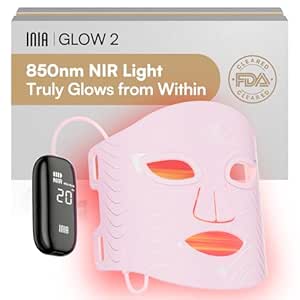 | Best for Adjustable Session Lengths | Wavelengths: Red-L 620 nm; Red-H 630 nm; near-infrared 850 nm; blue 460–470 nm; red + blue 460–630 nm | Light modes: 4 | LED chips: 220 | VIEW LATEST PRICE | See Our Full Breakdown |
More Details on Our Top Picks
INIA GLOW 4D Wireless Red Light Therapy Mask with Dual NIR and 320 LEDs
The INIA GLOW 4D is a good match for buyers who prioritize a mask that can flex around facial contours rather than extend treatment to the neck and chest. Its medical-grade silicone construction and wireless design make it easier to settle into a routine without staying tethered to a cord, while four light modes give it more variety than a red-only device. Dual NIR channels and a magnetic eye-area cooling pad add features that the face-and-neck INTEO B0FMXH8STX does not list. The tradeoff is narrower coverage: the INIA focuses on the face, so it is less suitable for anyone wanting one device for face, neck, and chest. Its 320 LEDs are also fewer than the INTEO’s 680 beads, and consistent use is still needed for the skincare results described.
Pros:- Flexible silicone is designed to conform to facial contours
- Red, blue, amber, and combination modes provide multiple settings
- Wireless design allows movement during sessions
- Magnetic cooling gel pad adds an eye-area cooling option
Cons:- Face-only coverage is less versatile than the face-and-neck INTEO models
- The supplied specifications do not state battery capacity or runtime
- Results described for the device require consistent use
Best for: Buyers seeking a wireless face-only mask with flexible silicone, several light modes, and a cooling eye-area accessory.
Not ideal for: People who want light coverage for the neck or chest, or who prefer a device with a stated battery capacity and runtime.
- LED count:320
- Light modes:Red, blue, amber, and combination
- Near-infrared:Dual NIR channels
- Material:Flexible medical-grade silicone
- Power design:Wireless
- Cooling feature:Magnetic cooling gel pad for the eye area
Our verdict“Choose the INIA GLOW if flexible face-only fit and eye-area cooling matter more to you than extended coverage or detailed battery specifications.”
Red Light Therapy Mask for Face and Neck – Wireless LED Face Mask with 4 Modes
This INTEO stands apart from the face-only INIA GLOW by covering the face, neck, and chest, making it the clearest pick here for buyers who want one device across a larger area. Its 680 silicone-encased beads and four specified wavelengths—red, blue, amber, and near-infrared—offer more detail than the broader mode descriptions on the INIA. The magnetic rechargeable battery and timer choices from 10 to 30 minutes also make sessions easier to fit into different routines. That expanded coverage has a physical cost: the mask may feel bulky across the chest, and the battery needs regular charging with up to 120 minutes of runtime per charge. Compared with the face-and-neck INTEO B0GHQBV831, this listing provides a more specific coverage description but does not state irradiance.
Pros:- Coverage extends across the face, neck, and chest
- 680 light beads are specified for the LED array
- Four wavelengths are listed with their nanometer values
- Rechargeable wireless design offers five timer settings
Cons:- The chest section may feel bulky for some users
- Runtime is limited to up to 120 minutes per charge
- The supplied specs do not state irradiance
Best for: Buyers who want a cordless LED device for the face, neck, and chest, with selectable wavelengths and flexible session timing.
Not ideal for: People who want a compact face-only mask, dislike bulky chest coverage, or do not want to manage regular recharging.
- Light beads:680
- Wavelength modes:630 nm red, 460 nm blue, 605 nm amber, 850 nm near-infrared
- Battery:2000 mAh rechargeable, Type-C
- Runtime per charge:Up to 120 minutes
- Timer settings:10, 15, 20, 25, and 30 minutes
- Material:Soft skin-friendly silicone
- Coverage area:Face, neck, and chest
Our verdict“Pick this INTEO over the face-only INIA GLOW when broad face-to-chest coverage is your priority and you can accommodate a larger mask.”
INTEO Red Light Therapy Mask for Face and Neck, 4 Wavelength Modes
The INTEO B0GHQBV831 is the more spec-detailed choice for buyers comparing face-and-neck masks: it lists 680 beads, four wavelengths, and 120 mW/cm² irradiance. That information gives shoppers more to compare than the INIA GLOW’s LED count and dual-NIR description, although specifications alone do not establish what results an individual will get. Like the other INTEO in this group, it is cordless, uses soft silicone, and offers timers from 10 to 30 minutes. Its stated face-and-neck coverage is more limited than the face, neck, and chest coverage listed for the INTEO B0FMXH8STX. The tradeoff is routine commitment: the product calls for multiple sessions each week, and its supplied claims are not backed by review content. It makes sense for detail-oriented shoppers, not those seeking substantiated outcome guarantees.
Pros:- Lists four wavelengths, including 850 nm infrared and 630 nm red
- Specifies 680 light beads and 120 mW/cm² irradiance
- Cordless controller charges via USB-C
- Five timer options include automatic shutoff
Cons:- Coverage is face and neck, not chest like the other INTEO model
- Recommended use involves multiple sessions each week
- Supplied product text does not provide review content supporting its claims
Best for: Shoppers comparing wavelength and irradiance specifications who want a rechargeable silicone mask for the face and neck.
Not ideal for: Buyers wanting chest coverage, strong evidence of individual outcomes, or a device that needs little routine commitment.
- Wavelengths:850 nm infrared, 630 nm red, 600 nm orange, 460 nm blue
- Light modes:4
- Light beads:680
- Irradiance:120 mW/cm²
- Battery:2000 mAh
- Charging:USB-C
- Timer settings:10, 15, 20, 25, or 30 minutes
- Runtime per charge:120 minutes per week, as stated in product data
- Material and coverage:Soft silicone; face and neck
Our verdict“Choose this INTEO if listed irradiance and wavelength details help you compare devices, but skip it if you need chest coverage or stronger outcome evidence.”
SDKWDH Red Light Therapy Face Mask with 850nm NIR
The SDKWDH is the most straightforward face-only option here for buyers who want built-in eye protection rather than an eye-area cooling accessory like the INIA GLOW’s magnetic gel pad. Its adjustable straps, food-grade silicone, and integrated controller keep the design focused on fitting and operating a single face mask. The four listed wavelengths include red, infrared, blue, and yellow, while the 10-to-30-minute timer and rechargeable battery give users several session lengths without a cord during use. It is less feature-rich on paper than Shark CryoGlow, which adds adjustable under-eye cooling and named treatment programs. It also has 273 LEDs, fewer than either INTEO’s 680-bead face-and-neck masks. The product text claims FDA clearance, but faster-results and salon-level claims are not substantiated in the supplied information.
Pros:- Built-in eye protection is included
- Adjustable straps and silicone construction support a customizable fit
- Four wavelengths include 850 nm infrared and 630 nm red
- Rechargeable battery and 10-to-30-minute timer support cordless sessions
Cons:- 273 LEDs are fewer than the 680 beads listed for the INTEO masks
- Face-only coverage does not extend to the neck or chest
- Faster-results and salon-level claims are not substantiated in the supplied text
Best for: Buyers who want an adjustable face mask with built-in eye protection, multiple wavelengths, and a rechargeable controller.
Not ideal for: People seeking neck or chest coverage, under-eye cooling, or a device with better-supported claims about treatment outcomes.
- Light wavelengths:850 nm infrared, 630 nm red, 460 nm blue, 590 nm yellow
- LED count:273
- Maximum irradiance:Up to 120 mW/cm²
- Battery:2000 mAh
- Charging:USB Type-C
- Runtime:Up to 120 minutes
- Timer:10–30 minutes
- Material and fit:Food-grade silicone with adjustable straps
- Eye protection:Built-in
Our verdict“Choose the SDKWDH for its built-in eye protection and adjustable face-only fit, not for expanded coverage or unsupported performance claims.”
Shark CryoGlow LED Face Mask with Red Light Therapy and Under-Eye Cooling
Shark CryoGlow is the distinct choice for shoppers who want under-eye cooling alongside LED treatments, rather than a simpler multi-wavelength mask like the SDKWDH. Its three adjustable chill levels and four named treatment programs give it a more guided, feature-led approach, with sessions lasting 4 to 15 minutes. That range may suit people who prefer shorter treatments, though the product still calls for regular daily use across treatment cycles. Shark lists red, blue, and deep infrared light, but the supplied specs do not give LED count, wavelengths, irradiance, battery capacity, or treatment-by-treatment durations. By comparison, both INTEO masks provide wavelength values, bead counts, and timer settings that make technical comparisons easier. CryoGlow is best for buyers who value cooling and preset routines more than detailed light-output specifications.
Pros:- Combines LED treatments with three adjustable under-eye chill levels
- Includes four named treatment programs for different skincare goals
- Treatment durations range from 4 to 15 minutes
- Includes a remote and USB-C charging cable
Cons:- Regular daily use is required for the treatment cycles described
- Supplied specs do not list LED count, wavelengths, or irradiance
- Individual results may vary
Best for: Buyers who want a guided face-mask routine with adjustable under-eye cooling and relatively short treatment sessions.
Not ideal for: Shoppers who prioritize stated LED counts, wavelength values, irradiance, or a mask that does not require regular daily use.
- Model:FW312PK
- Light types:Red, blue, and deep infrared LED
- Treatments:Better Aging, Skin Clearing, Skin Sustain, Under-Eye Revive
- Treatment duration:4–15 minutes, depending on treatment
- Under-eye cooling:Three adjustable chill levels
- Fit:Adjustable; designed for a range of face shapes and sizes
- Included accessories:Clip-On Chill Pads, remote, USB-C charging cable
- Listed skin types:Dry, oily, normal, combination, and sensitive
Our verdict“Choose Shark CryoGlow if under-eye cooling and guided, shorter sessions matter more than detailed light-output specifications.”
Aimilove Wireless Red Light Therapy Face Mask with 324 LEDs
The Aimilove is a practical pick for shoppers who want to move around during a session rather than stay beside an outlet. Its cordless design and stated battery life of up to 120 minutes make it more session-friendly between charges than a mask that depends on a nearby power source. It also combines multiple light modes, including red and blue, with gentle heat and full-face coverage. Compared with the iRestore mask, which specifies red, infrared, and blue wavelengths and a 10-minute session, Aimilove gives less wavelength detail but offers a more flexible, rechargeable format. The tradeoff is that its 850 nm NIR specification is the only wavelength listed, so buyers seeking detailed output information have less to assess. At 1.65 pounds, it is also not the lightest-sounding option, and recharging remains part of regular use.
Pros:- Cordless rechargeable design supports flexible at-home use
- Up to 120 minutes of use per charge
- Multiple modes include red and blue light, plus gentle heat
- Full-face coverage and a built-in auto timer
Cons:- Requires regular recharging to stay ready for sessions
- Product details list 850 nm NIR but do not specify wavelengths for each light mode
- At 1.65 pounds, it may feel less appealing to buyers prioritizing a lightweight mask
Best for: People who want a rechargeable mask for at-home sessions away from an outlet and value several light modes over detailed wavelength specifications
Not ideal for: Buyers who want a lightweight mask, clearly specified wavelengths for every mode, or a device that needs no charging routine
- LEDs:324
- Listed wavelength:850 nm NIR
- Light modes:Multiple, including red and blue
- Battery life:Up to 120 minutes
- Charging time:30 minutes
- Item weight:1.65 pounds
- Model number:RB-008
Our verdict“Choose Aimilove if cordless use and a long stated runtime matter more to you than detailed wavelength information or a particularly light design.”
Red Light Therapy Mask for Face and Neck with 396 LEDs
For shoppers who do not want their treatment area to stop at the jawline, this flexible silicone mask stands out for combining face-and-neck coverage with seven light modes. The listed 660 nm red and 850 nm near-infrared wavelengths give more specific information than the Aimilove listing, which names several modes but only specifies NIR wavelength. Adjustable straps, eye shields, and four session timers also make it easier to tailor fit and session length. Its 108 mW/cm² maximum irradiance is a useful product specification, but the provided description does not include independent evidence to support the treatment claims. Compared with the 4D mask, which focuses on a floating face fit and four selectable modes, this option covers more area and offers more modes, at the cost of a larger, more involved setup. It makes most sense for buyers willing to use a face-and-neck device consistently.
Pros:- Covers both face and neck
- Seven light modes, with red and near-infrared wavelengths specified
- Flexible silicone, adjustable straps, and included eye shields
- Four session timer options and a stated two-year replacement assurance
Cons:- Face-and-neck coverage may mean a more involved fit than a compact face-only mask
- The product description provides no independent evidence for its claims
- Requires consistent use, which may not suit buyers seeking a low-frequency routine
Best for: People who want one flexible device for both facial and neck coverage and prefer several mode and timer choices
Not ideal for: Shoppers who want a face-only mask, a minimal setup, or independently supported evidence for product claims
- LED chips:396
- Coverage:Face and neck
- Light modes:7
- Red light wavelength:660 nm
- Near-infrared wavelength:850 nm
- Maximum irradiance:108 mW/cm²
- Session timers:5, 10, 15, or 20 minutes
- Material and power:Flexible food-grade silicone; rechargeable
- Warranty:2-year replacement assurance
Our verdict“Pick this model if face-and-neck coverage is your priority and you are comfortable with a larger device and a regular routine.”
4D Red Light Therapy Face Mask – Soft Floating Fit, 4 Modes, 4000mAh Remote
The defining choice here is fit: this mask pairs adjustable silicone construction with a pressure-free design, appealing to buyers who dislike a mask pressing against the face. Its four wavelengths—red, infrared, orange, and blue—also offer more clearly stated color options than the Aimilove, whose wavelength details are limited. The 4000 mAh remote, timer, and auto shut-off are geared toward managing sessions without fuss, while three brightness levels add another adjustment. Compared with the Lanieney, which adds chilled under-eye pads and jaw coverage, this model concentrates on a floating face fit rather than cooling extras. Its description claims a fit for over 90% of female faces, but that does not establish fit for every user. Buyers should also expect regular sessions; the listing says visible results require use three to five times weekly.
Pros:- Pressure-free, adjustable silicone design
- Four specified wavelengths: red, infrared, orange, and blue
- Remote has a 4000 mAh battery, timer, and auto shut-off
- Three brightness levels allow session adjustments
Cons:- The stated fit claim does not guarantee a comfortable fit for every face
- The product description calls for three to five sessions per week for visible results
- Face-only coverage lacks the neck area included with the 396-LED face-and-neck mask
Best for: People who want an adjustable, low-pressure face mask with several specified wavelengths and remote session controls
Not ideal for: Shoppers seeking face-and-neck coverage, cooling accessories, or a device that does not call for frequent use
- LED count:328
- Wavelengths:Red 625 nm, infrared 850 nm, orange 600 nm, blue 460 nm
- Modes:4 selectable modes
- Brightness:3 levels
- Remote battery capacity:4000 mAh
- Material:Medical-grade silicone
- Fit:Adjustable straps; stated to fit over 90% of female faces
- Warranty:2-Year Total-Care Guarantee
Our verdict“Choose the 4D mask if a low-pressure adjustable fit and clearly listed wavelengths matter more than neck coverage or cooling features.”
Lanieney LED Red Light Therapy Mask with Cooling Pads
Lanieney is the most accessory-focused choice in this group: along with full-face and jaw coverage, it includes magnetic gel pads intended for under-eye cooling. That combination suits shoppers who want a cooling step alongside light sessions, rather than a bare-bones LED mask. Its 400 beads and wireless remote—with mode, timer, and brightness controls—give it a more feature-rich setup than the iRestore, whose listing emphasizes three wavelengths, eye shielding, and short sessions instead. Lanieney lists red at 630 nm and near-infrared at 850 nm, plus amber, blue, and purple modes, although wavelengths are not specified for those additional colors. The cooling pads need chilling before use, adding preparation that simpler masks avoid. The description also provides no measured results, so I would choose it for its coverage and accessories, not on the basis of unverified outcomes.
Pros:- Contoured design covers the full face and jaw
- Four light modes, with red and near-infrared wavelengths specified
- Includes a pair of magnetic cooling gel pads
- Wireless remote and on-mask controls adjust mode, timer, and brightness
Cons:- Cooling pads need chilling before use
- Wavelengths are not specified for the amber, blue, and purple modes
- The product description provides no measured results
Best for: People who want a wireless mask with jaw coverage, adjustable controls, and separate under-eye cooling pads
Not ideal for: Buyers who want a simple ready-to-use routine, independently measured results, or full wavelength details for every mode
- LED beads:400
- Coverage:Full face and jaw
- Light modes:Red and near-infrared, amber, blue, and purple
- Red wavelength:630 nm
- Near-infrared wavelength:850 nm
- Cooling pads:Pair of magnetic gel pads
- Controls:Wireless remote and controls on the mask
- Design:Wireless, 3D contoured
Our verdict“Pick Lanieney if jaw coverage and under-eye cooling accessories are more useful to you than a simpler, evidence-focused device.”
iRestore LED Red Light Therapy Face Mask with 360 LEDs
iRestore makes the shortlist for shoppers who prefer a clearly defined session: its guidance specifies 10 minutes, three to five times per week. It lists 635 nm red, 830 nm infrared, and 415 nm blue light, giving buyers more wavelength detail than the Aimilove’s listing. The eye shielding and dual straps address two practical parts of wearing a mask, while the lightweight design may appeal to people who do not want extra weight on the face. Compared with the 4D mask, iRestore has fewer listed adjustment features—there are no stated brightness settings or remote battery capacity—but its shorter, more specific routine is easy to understand. One notable tradeoff is its hovering fit rather than direct facial contact, which may not suit shoppers who want a close-fitting mask. Regular sessions are still required.
Pros:- Lists red, infrared, and blue wavelengths
- Eye shielding helps block direct light from the eyes
- Lightweight design with dual straps
- Recommended sessions are a defined 10 minutes
Cons:- The mask is described as hovering over the face rather than making direct contact
- Recommended use still calls for three to five sessions per week
- The listing does not specify adjustable brightness or remote controls
Best for: People who prefer a defined 10-minute routine and want a lightweight face mask with three specified wavelengths and eye shielding
Not ideal for: Shoppers who want direct-contact fit, neck coverage, or remote and brightness controls
- LEDs:360
- Red wavelength:635 nm
- Infrared wavelength:830 nm
- Blue wavelength:415 nm
- Session duration:10 minutes
- Recommended frequency:3–5 times per week
- Design:Lightweight mask with dual straps and eye shielding
Our verdict“Choose iRestore if you want a lightweight mask with eye shielding and a clearly defined short session, and do not mind a hovering fit.”
Ulike Red Light Therapy Mask – 360° Full Face Coverage
Ulike stands out for combining four light modes with 360° full-face coverage, giving buyers options for brightness, firmness, rejuvenation, and acne-focused routines in one mask. Its suggested eight-minute sessions are shorter than the 10–20-minute sessions recommended for the MEGELIN face-and-neck mask, which may make daily use easier to fit into a routine. The silicone eye mask and 1 cm skin gap are intended to support coverage and comfort, though fit can still feel bulky for some users. The tradeoff is that the rechargeable remote needs to be charged before treatment, and the promised benefits depend on regular use. I’d choose Ulike over a simpler-mode mask for variety, but skip it if you want neck coverage or dislike managing a separate remote.
Pros:- Four modes target different skincare concerns
- 360° coverage is designed to distribute light across the face
- Eight-minute suggested sessions are relatively brief
- Silicone eye mask is included for eye-area protection
Cons:- Rechargeable remote must be charged before use
- The mask may feel bulky on some faces
- Benefits depend on consistent use
Best for: People who want several light-mode options and short, frequent face-only sessions at home
Not ideal for: Buyers seeking face-and-neck coverage or a slim mask that feels unobtrusive during treatment
- Light beads:272
- Modes:4: Glow, Firm, Rejuvenate, Clear
- Coverage:360° full face
- Skin gap:1 cm
- Eye protection:Silicone eye mask
- Power source:Rechargeable remote control
Our verdict“Choose Ulike if you value multiple modes and short sessions more than a lightweight fit or neck coverage.”
MEGELIN LED Red Light Therapy Face and Neck Mask
MEGELIN’s strongest distinction is its separate face and neck coverage, an advantage over the face-only Ulike mask for buyers who want both areas in one routine. It pairs flexible silicone with adjustable straps and eye pads, while its seven light settings span a stated 420–850 nm range. The foldable design also suits storage or travel better than a bulkier rigid setup. Its recommended 10–20-minute sessions, three to four times weekly, take more time than Ulike’s suggested eight-minute routine, and the provided details do not specify the individual wavelengths for each setting. The mask must also be used unplugged, so it cannot run while charging. I’d favor MEGELIN for broader coverage, but choose a face-only option if a simpler setup matters more than treating the neck.
Pros:- Includes both face and neck masks
- Flexible silicone construction folds for storage
- Seven light settings across a stated 420–850 nm range
- Adjustable straps and eye pads are included
Cons:- Cannot be used while charging
- Recommended sessions can last up to 20 minutes
- Individual wavelengths for the seven settings are not specified
Best for: Buyers who want one flexible, rechargeable device for face and neck treatments
Not ideal for: People who need to use a mask while it charges or want clearly listed wavelengths for each color setting
- Material:Flexible silicone
- Light settings:7 colors
- Wavelength range:420–850 nm
- Face mask LEDs:288
- Neck mask LEDs:198
- Recommended session:10–20 minutes
- Recommended frequency:3–4 times per week
- Power:Rechargeable; do not use while charging
- Warranty:365 days
Our verdict“Pick MEGELIN if face-and-neck coverage is your priority and you can use it unplugged for regular sessions.”
Red Light Therapy Face Mask – FDA-Cleared Blue Light for Acne
The MICEYLIVE mask is a fit for buyers who prefer corded power over a rechargeable controller: it avoids battery charging between sessions and is specified with red, blue, and near-infrared wavelengths. Its 415 nm blue light gives acne-prone users a clearly stated wavelength to compare with the INIA mask’s 460–470 nm blue range. The flexible silicone construction is described as providing up to 99% facial fit, and the 10-minute treatment is shorter than MEGELIN’s recommended sessions. The tradeoff is practical rather than complicated: a power outlet is required nearby, so it is less convenient for travel or treatment away from a seated setup. The product title claims FDA clearance for blue light, but buyers should verify the applicable device and clearance details if that status is a deciding factor.
Pros:- Lists red, blue, and near-infrared wavelengths
- Corded power avoids controller battery drop-off
- Flexible silicone is designed for near-full facial coverage
- Includes eye pads and a travel bag
Cons:- Requires a nearby power outlet
- Cord limits movement and portability
- The 10-minute, 3–5-times-weekly routine still requires regular use
Best for: Buyers with acne-prone skin who want specified red, blue, and near-infrared wavelengths and do not need cordless use
Not ideal for: Frequent travelers or anyone who wants to move freely during a session without staying near an outlet
- LED count:432
- Red light wavelength:630 nm
- Blue light wavelength:415 nm
- Near-infrared wavelength:850 nm
- Power density:Up to 105 mW/cm²
- Facial coverage:180° flexible; stated 99% fit
- Power source:Corded
- Warranty:18 months
- Included accessories:Eye pads and travel bag
Our verdict“Choose MICEYLIVE if wavelength detail and steady corded power matter more to you than cordless convenience.”
RENPHO Rejuven Artemis Red Light Therapy Mask for Face with 324 LEDs
RENPHO’s appeal is its contoured face-and-jaw coverage, which makes it a more targeted choice than the face-and-neck MEGELIN when your priority is the lower face rather than the neck. It uses 324 LEDs and keeps its controls conceptually simple with three modes: red plus infrared, blue, and mixed light. Lightweight, skin-friendly silicone and protective eye cups are intended to make home sessions more comfortable, including while reading or relaxing. Unlike the Ulike mask, RENPHO’s listed modes are fewer, so it offers less variety for shoppers who want multiple named treatment programs. The eye cups may also restrict convenience while wearing it, and the product data gives no session length or power details. I’d shortlist it for jaw coverage, not for buyers who need a fully specified routine.
Pros:- Contoured design covers the face and jaw
- Three modes include red plus infrared, blue, and mixed light
- Lightweight, skin-friendly silicone construction
- Protective eye cups are included
Cons:- Eye cups may limit comfort or convenience while wearing the mask
- Visible improvements require consistent use over several weeks
- Session length and power details are not provided
Best for: Home users focused on face and jaw coverage who prefer a small set of straightforward light modes
Not ideal for: Buyers who want face-and-neck treatment, detailed session and power specifications, or an unobstructed fit around the eyes
- LEDs:324
- Light modes:Red + infrared, blue, mixed light
- Coverage:Face and jaw
- Material:Skin-friendly silicone
- Included accessories:Protective eye cups
Our verdict“Choose RENPHO for its face-and-jaw shape and simpler mode selection, but look elsewhere if you need detailed usage specifications.”
INIA Red Light Therapy Mask with Near-Infrared and Blue Light
INIA is the most flexible pick here for users who want to set treatment duration themselves: its controller offers 10-, 20-, or 30-minute sessions and shuts off automatically. Four modes combine red, near-infrared, and blue light, with near-infrared activation optional. That control is a contrast with Ulike’s shorter eight-minute routine, while MICEYLIVE provides a more detailed account of its individual wavelengths and corded power. INIA lists wavelengths for its red, near-infrared, and blue settings, plus output up to 105 mW/cm², but its 220 LED chips are fewer than the 432 in MICEYLIVE. The description also omits mask dimensions and fit details, making it harder to judge comfort or coverage before buying. I’d pick it for timer choice, not for a carefully specified fit.
Pros:- Four modes include red, near-infrared, and blue options
- Near-infrared activation is optional
- Selectable 10-, 20-, or 30-minute sessions
- Rechargeable controller includes automatic shutoff
Cons:- Mask dimensions and fit details are not specified
- Has fewer LED chips than the MICEYLIVE mask
- Regular sessions of up to 30 minutes may be a significant time commitment
Best for: Buyers who want selectable treatment lengths, automatic shutoff, and optional near-infrared use
Not ideal for: Shoppers who need detailed fit or dimension information, or who prioritize a higher stated LED count
- Wavelengths:Red-L 620 nm; Red-H 630 nm; near-infrared 850 nm; blue 460–470 nm; red + blue 460–630 nm
- Light modes:4
- LED chips:220
- Energy output:Up to 105 mW/cm²
- Controller battery capacity:2600 mAh
- Session timer:10, 20, or 30 minutes
- Automatic shutoff:Yes
Our verdict“Choose INIA if timer flexibility and optional near-infrared matter more than detailed fit information or a higher LED count.”

How We Picked
I compared each mask on buyer-facing factors: the light features named for the model, coverage, fit and wear format, controls, and added functions. I gave more weight to a useful combination of these factors than to headline LED counts alone. Wireless operation, face-and-neck coverage, cooling, and blue-light modes can each improve the fit for a particular routine, but none is an automatic advantage for every buyer.
The order reflects how well each option serves a clear need while keeping its tradeoffs visible. The INIA GLOW 4D takes the lead because its listed dual near-infrared feature and wireless design sit alongside a substantial LED array. Picks with more specialized features follow where those features matter to a narrower group; the remaining options are distinguished by coverage, wavelength modes, or their stated design rather than treated as interchangeable. Product names and listed features do not establish clinical results, so I avoid ranking on promised outcomes.
Factors to Consider When Choosing Best Red Light Therapy Masks
Before choosing among the best red light therapy masks, decide what will make the device usable in your routine. The feature list can help narrow the field, but fit, instructions, and the treatment area often matter more than a single headline number.
Match coverage to the area you actually want to treat
A face-only mask and a face-and-neck design are not equivalent, even if both use red light. Decide whether neck coverage is part of your routine before paying for an extended design. Check product images and included pieces for the areas the device covers; a name that mentions the neck is not a substitute for verifying the layout. Wider coverage can mean more material to position and store, so it may be less convenient if you only want facial use. If your target area is limited, a simpler mask can be easier to handle. Avoid buying extra coverage on the assumption that it automatically produces better results.
Read wavelength and mode details as separate choices
Red light, near-infrared, and blue light are distinct features, not interchangeable labels for the same routine. Look for the wavelengths and modes actually listed, then compare them with the purpose described in the product instructions. A multi-mode mask can offer flexibility, but more modes may also mean more settings to understand and manage. Blue light is a specialized feature, so do not select it just because it appears on a feature list. Likewise, near-infrared should not be assumed to replace red light. If a listing is vague about which lights operate together or how to select modes, treat that uncertainty as a drawback.
Prioritize fit and comfort over a high LED count
LED totals make quick comparisons easy, but they do not tell you how the mask sits on your face or how much of the intended area it covers. Fit affects whether the device stays in place and whether you are likely to follow its routine. Check how the mask is secured, whether it is rigid or flexible, and what the product says about positioning. A soft or floating-fit design may appeal to someone who dislikes a close-fitting shell, while a structured design can feel more stable to another buyer. Do not assume that more LEDs mean better coverage without looking at their placement. When comfort is unclear, favor clear fit details over a bigger number.
Choose controls and power for your routine
Wireless construction can make a session easier to fit around other tasks, but it also makes the controller and charging arrangement part of the buying decision. Check whether the controls are built into a remote, how modes are selected, and what battery information the listing provides. A listed battery capacity, such as 4000mAh, is not by itself a guarantee of runtime. Wired or more structured designs may be a better match if you plan to stay seated and prefer fewer pieces to keep charged. Avoid assuming that every mask with a wireless label offers the same ease of use. Match the setup to where and how you expect to use it.
Decide whether an extra feature earns its place
Cooling pads, under-eye cooling, and additional light modes can separate one mask from another, but they also add complexity. Ask whether the feature addresses a need you already have or merely makes the listing sound more advanced. Cooling is a separate function from the light routine, so it should not be your only reason to choose a mask if your priority is light coverage. A model with several modes may be useful if you intend to use them, but a simpler interface can be easier for a first-time buyer. Compare what is included and how the added feature works before treating it as a benefit. Pay for complexity only when it fits your actual routine.
Check instructions, safety information, and evidence claims
Read the manufacturer’s instructions for use, session timing, cleaning, and eye protection before choosing a device. Do not treat general red-light research as proof that every mask delivers the same results; device specifications and study conditions can differ. An FDA-cleared label, where listed, applies to the stated device and use, so read what the clearance covers rather than extending it to other models. Check whether the manufacturer explains cleaning and storage, especially for masks with removable or extended pieces. If you have a condition, take medication that affects light sensitivity, or are unsure whether light exposure is appropriate for you, ask a qualified clinician before use. Clear instructions are a meaningful part of a product’s usability, not an afterthought.
Frequently Asked Questions
Should I choose a mask with more LEDs?
Not on that number alone. LED count does not tell you how evenly the lights are positioned, how the mask fits, or which wavelengths it uses. In this lineup, models list counts ranging from 320 to 396, but the INIA GLOW 4D ranks ahead of some higher-count options because its stated dual near-infrared feature and wireless format make for a more rounded feature set. Compare the layout, light modes, and fit details before using LED count as a tiebreaker. If those details are missing, treat the count as incomplete information rather than proof of performance.
Is a face-and-neck mask a better choice than a face-only mask?
It is a better match only if you want to include your neck in your routine. Extended coverage can reduce the need to manage a separate device, but it may also take more effort to position and store. Check whether the neck section is part of the mask or a separate piece, and confirm which areas the lights cover. A face-only option can make more sense if you want a smaller, simpler setup. Let the area you plan to treat—not the broader product name—decide.
Do I need near-infrared or blue light?
Neither feature is a universal requirement, and they should not be treated as interchangeable. Near-infrared appears in several lineup options, including the INIA GLOW 4D and SDKWDH, while the INIA model with near-infrared and blue light adds another mode. A separate FDA-cleared blue-light mask is aimed at buyers specifically considering that feature. Check the instructions and intended use for each mode rather than assuming more wavelengths mean a better fit. If you have a medical concern or sensitivity, ask a clinician before adding light-based care to your routine.
Is a wireless mask worth choosing over a wired one?
Wireless operation can make a mask easier to wear away from an outlet, but it adds a battery and controller to manage. Consider where you expect to use it and whether you prefer moving around or sitting near a power source during a session. Check the stated charging details and controls, since a battery-capacity figure alone does not establish how long a charge lasts. A wired setup may suit someone who values a simpler power arrangement. Choose the format you are more likely to use consistently, not the one that sounds more advanced.
How should I choose between the Shark CryoGlow and a mask focused on light modes?
Choose based on whether under-eye cooling is a feature you will use, rather than assuming it improves the light-therapy function. The Shark CryoGlow’s distinction in this roundup is its cooling feature, while masks such as the INTEO and INIA models emphasize multiple light modes. If cooling is a priority, review how that function is used and whether the mask’s fit works for you. If you want to focus on wavelength options, compare the listed modes and controls instead. The extra feature should solve a real preference, not distract from fit or clarity about the light settings.
Conclusion
For the strongest all-around feature mix in this lineup, I recommend the INIA GLOW 4D Wireless Mask as best overall. Buyers seeking a feature-rich alternative with a distinct design may prefer the 4D Red Light Therapy Face Mask, while value-minded shoppers should compare the simpler multi-mode and face-and-neck options against the features they will actually use rather than paying for extras. For a premium-style feature set, the Shark CryoGlow makes most sense when under-eye cooling is a priority; for beginners, I would favor a straightforward mask with clear controls and instructions over the most complicated mode list. Choose the FDA-cleared blue-light mask for a specific interest in blue light, or a face-and-neck model if broader coverage matters more than compact wear. In every case, verify fit, instructions, and the exact light modes before deciding.