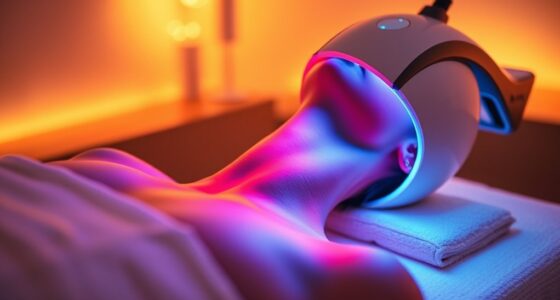
The biological-window theory explains that certain wavelengths, mainly in the red and near-infrared spectrum, penetrate skin deeper because your skin absorbs and reflects specific light ranges more effectively. These wavelengths match skin’s natural absorption properties, allowing them to pass through outer layers and reach deeper tissues like muscles and blood vessels. Understanding this helps optimize light therapies. Keep exploring to discover how choosing the right wavelengths can improve treatment outcomes and safety.
Key Takeaways
- Wavelengths within the biological window (650–950 nm) are less absorbed by superficial skin layers, enabling deeper tissue penetration.
- Skin’s selective absorption, influenced by pigmentation and hydration, allows certain wavelengths to pass through more effectively.
- Longer wavelengths, like near-infrared, align with skin’s absorption properties, facilitating deeper reach without superficial damage.
- Outside the biological window, wavelengths are more likely to be reflected or scattered, limiting their penetration depth.
- Understanding skin’s optical properties helps optimize light therapy by selecting wavelengths that maximize deeper tissue effects.
Have you ever wondered why certain biological processes occur only within specific time frames? It’s a question that leads to understanding how light interacts with our bodies, especially through the lens of the Biological‑Window Theory. This theory explains why specific wavelengths of light penetrate the skin more effectively, which is vital for applications like phototherapy. When considering phototherapy applications, knowing which wavelengths penetrate skin deeply helps maximize treatments for skin conditions and systemic illnesses. It’s all about harnessing the right part of the light spectrum to achieve the desired biological response without unnecessary exposure.
Skin absorption plays a pivotal role here. Your skin isn’t just a passive barrier; it selectively absorbs certain wavelengths of light while reflecting or scattering others. This selective absorption hinges on the skin’s properties, such as pigmentation, hydration, and thickness. For example, visible red and near-infrared light are absorbed more efficiently because their wavelengths align with the biological window—an ideal range where light penetrates deeper without causing damage. This is why red light therapy, a common phototherapy application, can stimulate cellular activity deep within tissues, promoting healing and reducing inflammation.
The Biological‑Window Theory pinpoints these specific wavelengths, typically spanning from about 650 to 950 nanometers, as the most effective for skin penetration. Within this range, light can pass through the outer layers of the skin, reaching deeper tissues such as muscles, joints, and even blood vessels. That’s why in phototherapy applications, practitioners prefer these wavelengths—they maximize therapeutic effects while minimizing potential harm. You can think of it as a biological sweet spot, where light is absorbed just enough to stimulate cellular processes without damaging skin or superficial layers.
Understanding skin absorption and the biological window helps explain why some wavelengths work better for certain treatments. For instance, shorter wavelengths like blue light are absorbed mostly by the superficial layers and are used for skin conditions like acne. Conversely, longer wavelengths in the near-infrared range penetrate more profoundly, reaching tissues beneath the skin’s surface. This knowledge enables clinicians to customize treatments for specific needs, whether it’s targeting surface infections or promoting deeper tissue repair. Recognizing the role of light physics**** in these interactions is fundamental to advancing effective phototherapy techniques.
In essence, the Biological‑Window Theory provides a scientific basis for selecting the ideal wavelengths in phototherapy applications. By focusing on how skin absorbs light within specific ranges, you can appreciate why certain wavelengths penetrate more deeply and are more effective for particular treatments. It’s the interplay of light physics and biological properties that reveal the potential of light-based therapies, making them safer and more efficient. Understanding these principles guarantees you’re better equipped to appreciate or even utilize phototherapy, maximizing benefits while minimizing risks.

bonodave Red Light Pad for Body Back Knee Shoulder Hands Feet 660nm 850nm Home Use 3 Chips in 1 Infrared Wrap Belt Gift for Women Men (Corded)
- Corded Red Light Therapy Pad: Gentle warmth with energy-efficient pulse mode
- Versatile Usage: Adjustable, easy-to-wrap design for any body part
- Suitable for Pets: Provides comfort and warmth for pets and family
As an affiliate, we earn on qualifying purchases.
As an affiliate, we earn on qualifying purchases.
Frequently Asked Questions
How Does Skin Type Affect Wavelength Penetration Depth?
Your skin type influences wavelength penetration because skin pigmentation affects how much light gets absorbed. Darker skin with higher melanin levels absorbs more wavelengths, reducing penetration depth. Conversely, lighter skin absorbs less, allowing wavelengths to penetrate deeper. Understanding how wavelength absorption varies with skin type helps optimize treatments, ensuring you target the right layers without damaging surface tissue.
Can Biological Window Wavelengths Treat Internal Organs Effectively?
Oh, sure, just wave some light at your insides and hope for the best, right? Well, in truth, biological window wavelengths are carefully optimized for phototherapy applications, making them surprisingly effective for treating internal organs. You see, these wavelengths penetrate deeper, so with proper wavelength optimization, they can target tissues beneath the skin. But don’t expect a magic wand—it’s all about precise science, not just shining light and crossing fingers.
Are There Safety Concerns With Using Specific Wavelengths?
You should be aware that using specific wavelengths raises laser safety concerns, especially regarding skin and tissue damage. Wavelength regulation is essential to prevent overexposure and unintended harm. Always follow safety protocols, use appropriate protective gear, and make certain devices are properly calibrated. By adhering to these guidelines, you minimize risks, making treatments safer for both practitioners and patients. Safety measures are indispensable when working with targeted wavelengths.
How Do Different Skin Diseases Influence Light Absorption?
Imagine your skin revealing secrets through light—different diseases change how it absorbs wavelengths. You might not realize that conditions like psoriasis or vitiligo alter pigmentation, impacting phototherapy applications. These changes can either enhance or hinder treatment effectiveness, especially considering skin pigmentation effects. By understanding how diseases influence light absorption, you can optimize therapies for better outcomes, revealing new possibilities in skin health and healing that keep you ahead in skincare innovation.
What Technological Advancements Are Improving Wavelength Targeting?
You should explore technological advancements like laser calibration and spectral imaging, which are enhancing wavelength targeting. Laser calibration guarantees precise control of laser settings for ideal penetration, while spectral imaging allows you to accurately identify specific wavelengths that penetrate skin more effectively. These innovations help improve treatment efficacy, reduce side effects, and enable personalized therapies, making your approach to wavelength targeting more accurate and impactful.
Conclusion
Understanding the Biological-Window Theory shows you why certain wavelengths, like near-infrared, penetrate skin deeper. Imagine using a specific wavelength to target a deep-seated tumor without harming surrounding tissue—this could enhance treatments markedly. By choosing the right wavelengths, you can optimize medical procedures, improving outcomes and reducing side effects. So, whether for healing or diagnostics, tapping into these biological windows helps you harness light’s full potential for better health.