TL;DR
Personal trainer Pippa Sealey recommends using shorter rest periods and unilateral exercises to keep home dumbbell workouts challenging when heavier weights are unavailable. A Fit&Well report presents a workout built around supersets and single-sided movements, but does not provide evidence that the approach produces better results than other training methods.
Personal trainer Pippa Sealey recommends two ways to make home dumbbell sessions more challenging without buying heavier weights: shorter rest periods and unilateral exercises, which work one side of the body at a time. A Fit&Well report outlines a workout using those methods for people already comfortable with basic strength exercises.

Get wellness gear delivered free with Prime
- Fast, free delivery on millions of items
- Prime Video, Amazon Music and more included
- Member-only deals all year
Sealey says that when heavier loads are not available at home, she uses shorter rests and unilateral movements rather than bilateral exercises, which work both sides together. The report describes supersets as one way to shorten breaks: perform a set of one exercise, then move directly to a second exercise before resting. It also suggests agonist supersets, pairing moves that target the same muscle group to increase the challenge to that area.
The sample session combines supersets and tri-sets. For each group, the exerciser completes one set of each listed movement before resting, then repeats the sequence three times before moving on. The listed exercises include calf raises, hamstring bridge marches, wall sits, single-leg Romanian deadlifts, split squats, push-ups, a single-arm dumbbell row, side-plank hip lifts, plank dumbbell pull-throughs and sit-ups. The plan specifies three rounds, with some groups calling for 60 to 90 seconds of rest after the sequence.
The report says the workout is intended for people who are already confident with fundamental movements such as squats and deadlifts. It gives repetitions for most exercises, including 12 per side for the single-leg Romanian deadlift and split squat, and says to do push-ups for as many repetitions as possible while keeping good form. The article excerpt includes a single-arm push press in its exercise instructions, although that movement does not appear in the overview list provided in the source material.
Making Limited Home Weights Harder
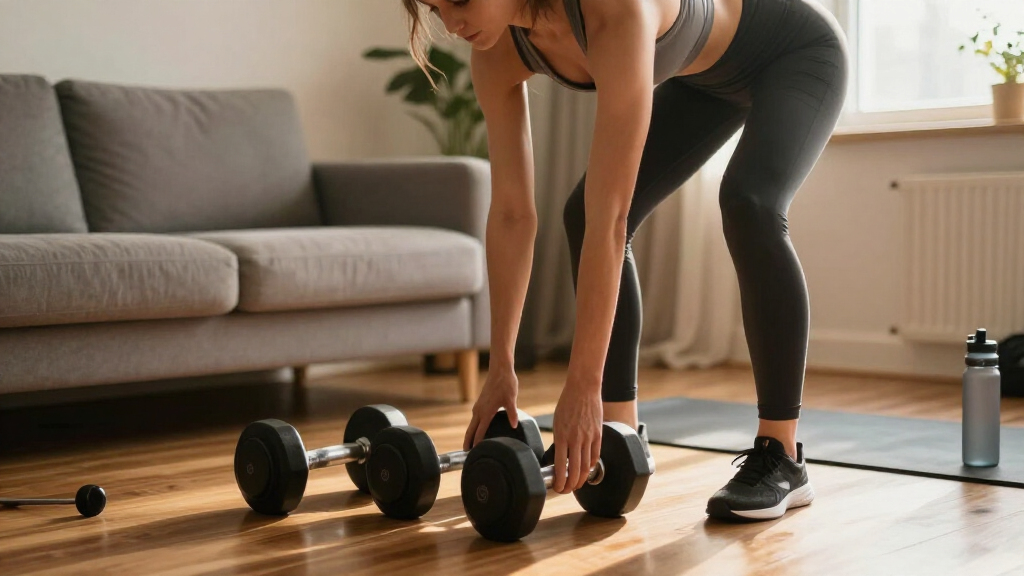
For people training at home with a fixed pair of dumbbells, Sealey’s suggestions offer ways to change the structure of a session without adding equipment. Shorter rests can make a workout feel more demanding, while one-sided exercises ask the body to control a movement on one side at a time. The workout’s combination of both approaches addresses a common practical limitation: having no heavier dumbbells available as strength or experience increases.
These are training suggestions, not a guarantee of progress. The source report does not provide study data, comparisons, or measurements showing how much the routine changes strength or fitness. Readers should treat the workout as an example rather than a personalized plan, and should adjust the exercises or rest periods if their form deteriorates.
Products Worth Considering

BowFlex Results Series SelectTech Adjustable Dumbbells (Pair)

BowFlex Results Series 552 SelectTech Adjustable Dumbbell

Garmin Venu 4 GPS Fitness Smartwatch, 45 mm, Black Silicone Band
As an affiliate, we earn on qualifying purchases.
The Workout’s Training Methods
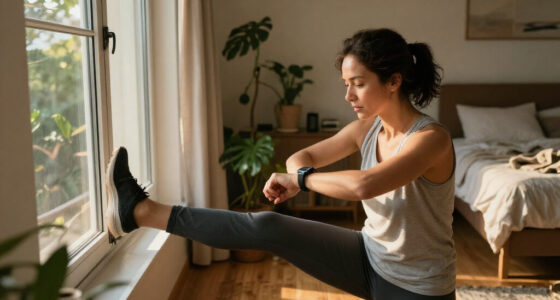
The report’s central idea is to adjust exercise selection and the time spent resting when equipment options are limited. A unilateral movement uses one side at a time; examples in the routine include single-leg Romanian deadlifts, split squats and single-arm work. The report contrasts this with bilateral movements, which use both sides together.
In a superset, two exercises are completed consecutively before a rest. A tri-set adds a third exercise to that sequence. The workout lists a calf-raise, bridge-march and wall-sit tri-set, followed later by a side-plank hip lift, dumbbell pull-through and sit-up tri-set. It also includes an agonist superset as an option, but the source excerpt does not identify a specific pairing for that technique. The plan is presented for people familiar with basic movements, not as an entry-level introduction to strength training.
“You may also want to use more agonist supersets.”
— Pippa Sealey, as quoted by Fit&Well
Limits of the Published Routine
The source material does not state when the report was published, nor does it give evidence comparing the routine with other workout plans. It is also unclear what dumbbell weights Sealey used, how often she recommends repeating the session, or how readers should progress once the listed exercises become easier. The overview and exercise instructions do not fully match: the overview lists a single-arm dumbbell row, while the supplied instructions include a single-arm dumbbell push press. Readers should check the original workout for the complete exercise order and any missing instructions.
The report does not provide individualized guidance on injuries, health conditions, or exercise modifications. The suggested repetitions and rest periods may not suit every person, and the workout’s intended audience is people who already know the fundamental movements.
How Readers Can Apply the Advice
The source report does not announce a follow-up study, program, or scheduled update. For readers considering the session, the immediate next step is to review the full exercise instructions and choose weights and variations they can control. The report emphasizes maintaining good form, particularly for push-ups and single-leg movements; stopping a set when technique breaks down is consistent with that guidance.
People who are new to strength training, have an injury, or have a pre-existing health condition may want to seek qualified professional guidance before trying the routine. The effect of shorter rests and unilateral work on an individual’s progress will depend on their starting point, exercise execution and training schedule; the cited report does not quantify those outcomes.
Key Questions
What two methods does Pippa Sealey recommend?
Sealey recommends shorter rest periods and unilateral exercises, which work one side of the body at a time, when heavier dumbbells are not available.
What is a superset in this workout?
A superset is a sequence in which a person completes one set of an exercise and then a set of a second exercise before resting. A tri-set adds a third movement before the rest.
Who is the routine intended for?
The Fit&Well report describes it as a workout for people already confident with basic exercises such as squats and deadlifts. It is not presented as a beginner plan.
Does the report show that the methods guarantee better results?
No. It reports Sealey’s training suggestions and a sample session, but provides no study data or quantified evidence that the methods guarantee specific strength or fitness results.
Source: rss