
To photograph results honestly, use consistent lighting with correct color temperature and avoid over-polishing images. Set up your camera with fixed settings, framing, and angles to guarantee comparability. Keep backgrounds clean and uncluttered for clear visuals. Focus precisely and expose correctly, avoiding any tricks that might mislead viewers. Take multiple shots for accuracy and compare side-by-side without editing. Mastering these steps will help you showcase true progress, and if you keep going, you’ll discover even more effective tips.
Key Takeaways
- Use consistent camera settings, lighting, and angles to ensure accurate, comparable images over time.
- Avoid heavy editing or filters; present photos as-is to maintain honesty and true representation.
- Include reference objects for scale and capture from straight-on perspectives to prevent distortion.
- Regularly review images for focus, exposure, and color accuracy to detect discrepancies early.
- Document your setup and settings to ensure reproducibility and trustworthy documentation of results.
Why Honest Photos Are Key to Showing True Progress
Honest photos are vital because they provide an accurate picture of your progress. When you prioritize photo honesty, you guarantee that the images truly reflect your results without exaggeration or misrepresentation. Color accuracy is essential here because it captures the true tones and details of your body and physique, giving you a reliable view of changes over time. If your photos are misleading or altered, you might incorrectly think you’re making progress or missing improvements. Authentic photos keep you honest with yourself, helping you stay motivated and focused. Remember, the goal is to track real progress, and honest images—free from filters or edits—are the best way to do that. They serve as trustworthy evidence of your journey. Additionally, understanding how to take vetted photos can ensure your images are consistent and meaningful for tracking progress. Ensuring proper lighting can also significantly enhance the accuracy and reliability of your photos, making your progress easier to assess objectively. Using weather-resistant gear and equipment can also help maintain consistent conditions when capturing your photos over time. Incorporating consistent positioning techniques further ensures that your photos are comparable, providing clearer insights into your progress. Being aware of photo guidelines can help you avoid common pitfalls and improve your photo quality.
How to Choose Lighting That Shows Colors and Details Accurately

Choosing the right lighting is essential for capturing accurate colors and details in your photos. To achieve this, focus on proper color calibration, which ensures your camera’s color reproduction matches real life. Use light sources with consistent color temperature, measured in Kelvin, to avoid color shifts. Neutral daylight or daylight-balanced bulbs around 5000K to 6500K are ideal, as they mimic natural light and reveal true hues. Avoid mixed lighting, which can cause inconsistent color rendition. If your environment has different light sources, consider using a light meter or adjusting your camera’s white balance settings to match the light temperature. Additionally, understanding light color temperature can help you select the most accurate lighting for your scenes. When selecting lighting equipment, consider options that provide consistent illumination to maintain uniform color accuracy across your shots. This way, your images will accurately reflect the true colors and fine details of your subject, providing honest and reliable results.
Setting Up Your Camera for Consistent, Honest Shots
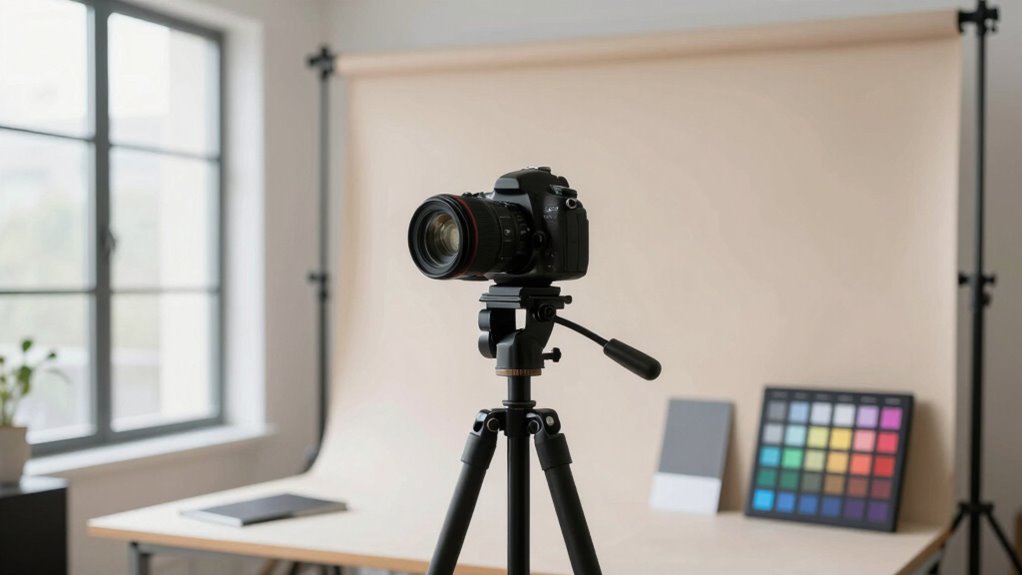
To guarantee your photos remain consistent and true to life, it’s essential to set up your camera properly before shooting. Start by adjusting your camera settings—set the ISO low to minimize noise, choose a narrow aperture for depth of field, and set the white balance to match your lighting conditions. Use manual focus to ensure sharpness and avoid auto adjustments that can vary between shots. Keep your exposure consistent by using the same settings across all images. This consistency helps you compare images accurately, giving you honest, reliable documentation of your work without the risk of fooling yourself with manipulated or inconsistent photos. Paying attention to camera calibration ensures your equipment produces accurate colors and exposure, further enhancing the integrity of your images. Additionally, regularly reviewing your camera’s performance can help identify any drift in settings that might affect your results. Maintaining proper color accuracy is crucial for truthful representation in your photographs, and understanding your camera’s dynamic range can help you capture more detail in highlights and shadows. Remember that consistent lighting conditions are also essential for honest results, as changing light can alter the appearance of your subject significantly.
Picking Angles and Perspectives to Prevent Distortion

Choosing consistent angles helps keep your photos accurate and balanced. Avoid getting too close to your subject, as this can cause distortion and make things look unusual. By minding your perspective, you guarantee your images represent the results clearly and professionally. Additionally, understanding visual representation ensures your photos accurately convey your intended message. When photographing your dogs or other pets, consider their unique features and breed characteristics to better capture their true appearance. Being mindful of distortion prevention techniques can further improve the quality of your photos. Furthermore, paying attention to jewelry measurements and materials can help you showcase modifications more precisely. Recognizing the plant parts used in herbalism can also guide you in capturing detailed and informative images of herbal remedies.
Use Consistent Angles
Maintaining consistent angles and perspectives is crucial to producing accurate and professional-looking photographs. When you keep your camera angle stable, you prevent distortion that can misrepresent your results. Consistency in lighting ensures your photos are comparable and clear. To achieve this, consider the following:
- Use a tripod to maintain angle stability during each shot
- Mark your camera position and height for repeatability
- Capture images under similar lighting conditions for lighting consistency
- Avoid tilting the camera unless intentional for artistic reasons
- Take notes on your setup to replicate your angles precisely
- Incorporate tracking gear to verify your subject’s position and movement, ensuring your photos accurately reflect your training results
Sticking to these practices helps ensure your photos remain true to the actual results, making comparisons straightforward and reliable. Consistency is key to avoiding misleading impressions and accurately documenting your work.
Avoid Close-Up Distortions
When photographing close-up details, selecting the right angle and perspective is essential to prevent distortion that can misrepresent your subject. Lens distortion often occurs when you shoot too close with wide-angle lenses, especially in macro photography, causing parts of your subject to appear exaggerated or skewed. To avoid this, keep your camera parallel to the subject and use a lens with minimal distortion, like a macro lens designed for close-up work. Stay at an appropriate distance to prevent exaggerated perspective, and avoid tilting your camera, which can create unnatural elongations. By carefully choosing your angle and perspective, you ensure your images accurately reflect what you see, reducing distortions and providing clear, truthful results.
Keeping Backgrounds Clean and Clutter-Free for Clear Results

To get clear, professional-looking photos, you need to keep backgrounds free of distractions. Minimize visual clutter by removing unnecessary items and focusing on your subject. Using simple backdrops helps your main subject stand out and keeps the viewer’s attention where it belongs. Additionally, choosing high-quality investment options can ensure your results are as valuable as your presentation. Incorporating proper lighting techniques can further enhance the clarity and appeal of your photographs, making your subject truly stand out. Remember that digital decluttering also plays a role in creating a clean visual environment, helping your images convey professionalism and focus.
Minimize Visual Distractions
A cluttered background can easily distract from the main subject of your photograph, making it harder for viewers to focus on what matters most. To minimize visual distractions, start with proper background cleanup, removing unnecessary items and ensuring a tidy space. Pay attention to color calibration so the background doesn’t clash or draw attention away from your subject. Use neutral or solid backgrounds to keep the focus sharp. Keep an eye on lighting to avoid harsh shadows or glare that can divert attention. Consider the following tips:
- Simplify the background by removing clutter
- Use plain, neutral backdrop colors
- Ensure consistent color calibration
- Adjust lighting to reduce glare
- Keep the scene free of distracting elements
These steps help create clean images with clear results, free from visual noise.
Use Simple Backdrops
Using simple backdrops is essential for achieving clear, focused photographs. A clean, uncluttered background helps guarantee color accuracy, so your results look true to life. Opt for neutral colors or solid shades that won’t compete with your subject. Avoid busy patterns or distracting objects that can divert attention and distort perception. The goal is to keep the backdrop simplicity, allowing your subject to stand out clearly. This visual clarity minimizes visual noise and makes it easier to evaluate your results accurately. When backgrounds are clean and simple, it’s easier to spot imperfections and assess true color, texture, and detail. Incorporating regional flavors and understanding their unique characteristics can further enhance the authenticity of your images. Maintaining a clutter-free environment is also crucial to prevent unwanted distractions from affecting your focus on the subject. Consistently using minimalist backdrops can help you develop a reliable visual style that highlights your work’s true qualities without fooling yourself about the quality or true appearance of your work. Additionally, considering lighting conditions can greatly improve the overall clarity and accuracy of your photographs.
Using Scale and Reference Items to Show True Size

Including a scale or reference item in your photograph is essential for accurately conveying size. Without it, viewers might misjudge the true dimensions of your subject. Using clear scale references allows for an honest size comparison and prevents misconceptions. To effectively include these references, consider the following:
- Use common objects like a ruler or coin for quick scale
- Place the reference item close to the subject for clarity
- Keep the reference in the same plane to avoid distortion
- Use consistent lighting to highlight both items equally
- Capture the photo from a straight-on angle for accurate perspective
How to Focus and Expose Properly for Accurate Photos
To capture sharp, true-to-life photos, you need to focus correctly and set the right exposure. Your focusing techniques and exposure settings directly impact photo accuracy. Use autofocus or manual focus to ensure your subject is crisp; switch to single-point focus for precision. Adjust your ISO, aperture, and shutter speed to expose correctly—higher ISO for low light, narrower aperture for depth, faster shutter for motion. Here’s a quick guide:
| Focus Techniques | Exposure Settings | Tips |
|---|---|---|
| Single-point focus | Adjust ISO & shutter speed | Use a tripod in low light |
| Continuous focus | Balance aperture & exposure | Review photos regularly |
| Manual focus | Check histogram for accuracy | Use live view for critical focus |
Master these, and your photos will reflect reality accurately.
Tips to Avoid Tricks That Might Mislead Viewers

To keep your photos honest, use consistent lighting conditions so viewers see true results. Avoid overprocessing images, which can distort the scene and mislead your audience. Staying true to these principles helps guarantee your photos accurately represent what you’re showcasing.
Use Consistent Lighting Conditions
Consistent lighting is essential for accurate and honest photography. When your lighting conditions stay steady, you guarantee better lighting consistency and color accuracy across images. This helps viewers compare results without confusion or misinterpretation. To maintain consistency:
- Shoot in the same location with fixed lighting setups
- Use the same time of day or artificial lighting source
- Avoid changing light angles or intensities
- Use diffusers or reflectors to control light quality
- Keep camera settings constant for each shot
Avoid Overprocessing Images
While maintaining steady lighting helps guarantee your images are honest representations, overprocessing can undermine that integrity. When editing, focus on moderation to preserve color accuracy and avoid misleading viewers. Excessive adjustments—like overly saturated colors or sharpness—can distort the true appearance of your subject. Always compare your edited image to the original to ensure fidelity. Remember, subtle tweaks often improve clarity without compromising authenticity. Resist the temptation to enhance images to the point where they no longer reflect reality. By practicing editing moderation, you help viewers trust your work and maintain credibility. Keeping your images true to life not only respects your subject but also ensures your results stand up to honest evaluation.
Comparing Before-and-After Photos Honestly and Clearly
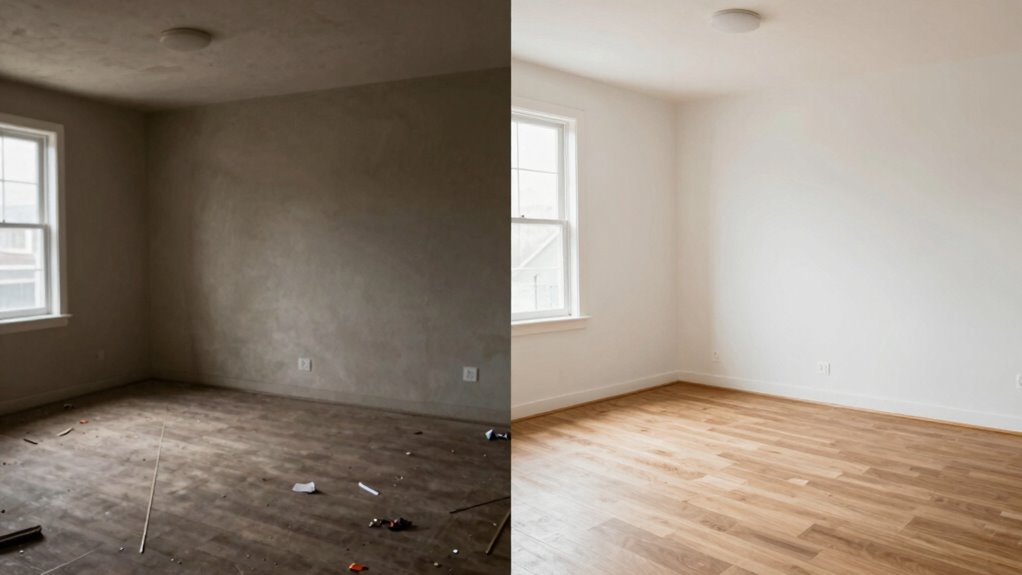
When comparing before-and-after photos, honesty and clarity are essential to maintain trust and provide an accurate assessment of results. To do this, focus on consistent lighting and color accuracy in both images. Variations can mislead your viewers and distort the true outcome. Keep these tips in mind:
Ensure honest comparisons by maintaining consistent lighting and color accuracy in before-and-after photos.
- Use the same lighting setup for both shots
- Match camera settings, including white balance
- Position the camera at the same angle and distance
- Avoid editing that alters colors or details
- Present images side-by-side for easy comparison
Reviewing and Adjusting Your Photos to Accurately Reflect Your Work

After capturing your photos, reviewing and adjusting them guarantees they truly represent your work. Start by examining your images on a neutral screen to spot any discrepancies. Use photo editing tools to correct exposure, contrast, and color balance, ensuring the photos match your actual results. Adjust your camera settings during the shoot, like ISO, aperture, or white balance, to minimize post-editing needs. Keep your edits subtle to maintain authenticity; avoid over-processing. Comparing the adjusted photos to your original work helps verify accuracy. Remember, consistent camera settings across shoots simplify editing and ensure you’re not misleading yourself. By carefully reviewing and making thoughtful adjustments, you create a truthful visual record of your results, avoiding the trap of overly polished or misleading images.
Frequently Asked Questions
How Can I Ensure My Camera Settings Remain Consistent Over Multiple Sessions?
To make certain your camera settings stay consistent across sessions, start with proper camera calibration and use manual mode. Set your light temperature to match your environment consistently, and avoid automatic adjustments. Use a tripod for stability and note your settings, so you can replicate them easily. Regularly check your calibration and color temperature, guaranteeing your photos remain reliable and comparable over time.
What Are Common Mistakes That Distort Photo Accuracy?
You should watch out for perspective distortion, which can skew your results, and poor color management, causing inaccurate color representation. Always use a tripod to keep your camera steady, and verify your lens is properly calibrated. Consistently use the same focal length and shooting angle to prevent distortion. Adjust white balance settings to maintain true colors, and compare your photos against a color calibration target to ensure accuracy.
How Do I Handle Reflections or Glare in Photos?
You handle reflections or glare by using polarized filters, which cut down on unwanted reflections and enhance color accuracy. Also, control your lighting by adjusting angles and diffusing light sources to minimize glare. Experiment with different positions, and don’t forget to review your shots frequently. This combo of polarized filters and careful lighting control guarantees your photos remain true to real results, helping you avoid misleading visuals.
What Equipment Can Improve Photo Honesty Without Breaking the Bank?
You can improve photo honesty with affordable gear like a basic tripod and a consistent light source to guarantee lighting consistency. Use a simple lightbox or diffuse your light to minimize glare and reflections. Opt for natural light when possible, or inexpensive LED lights that provide steady, even illumination. These tools help you capture accurate results without overspending, making your photos more truthful and reliable.
How Do I Document Changes Over Time Effectively?
Imagine it’s 1955, and you’re documenting your progress. To do this effectively, guarantee lighting consistency and background neutrality in each shot. Use a tripod to keep your camera steady, mark your camera position, and photograph at the same time of day. Keep your background simple and unchanging, and take notes on each session. This approach helps you accurately track changes over time without any illusions.
Conclusion
By staying honest with your photos, you’re forging a mirror that reflects your true progress, not a distorted funhouse. Clear, consistent shots are your honest storytellers, revealing the real journey behind each change. When you avoid tricks and keep your visuals genuine, your progress becomes a lighthouse guiding others through the fog of deception. Embrace transparency, and let your images be the authentic brushstrokes painting the masterpiece of your growth.