
TL;DR

Get wellness gear delivered free with Prime
- Fast, free delivery on millions of items
- Prime Video, Amazon Music and more included
- Member-only deals all year
Moving your rig into a closet and adding targeted acoustic treatment can drastically reduce noise and improve sound quality. Proper placement and ventilation are key to making a closet setup functional and quiet.
Ever wondered why your studio sounds like a muffled box, or why your noisy rig keeps disturbing your focus? The secret isn’t just in fancy foam panels or thick blankets. The biggest difference-maker is simply putting space between you and the noise source.
In this guide, you’ll learn how to turn a closet into a quiet, efficient workspace—without sacrificing practicality. Learn more about acoustic dampening and placement in home setups. From proper placement to ventilation tricks, I’ll show you how to tame heat and sound, making your setup both quiet and functional.
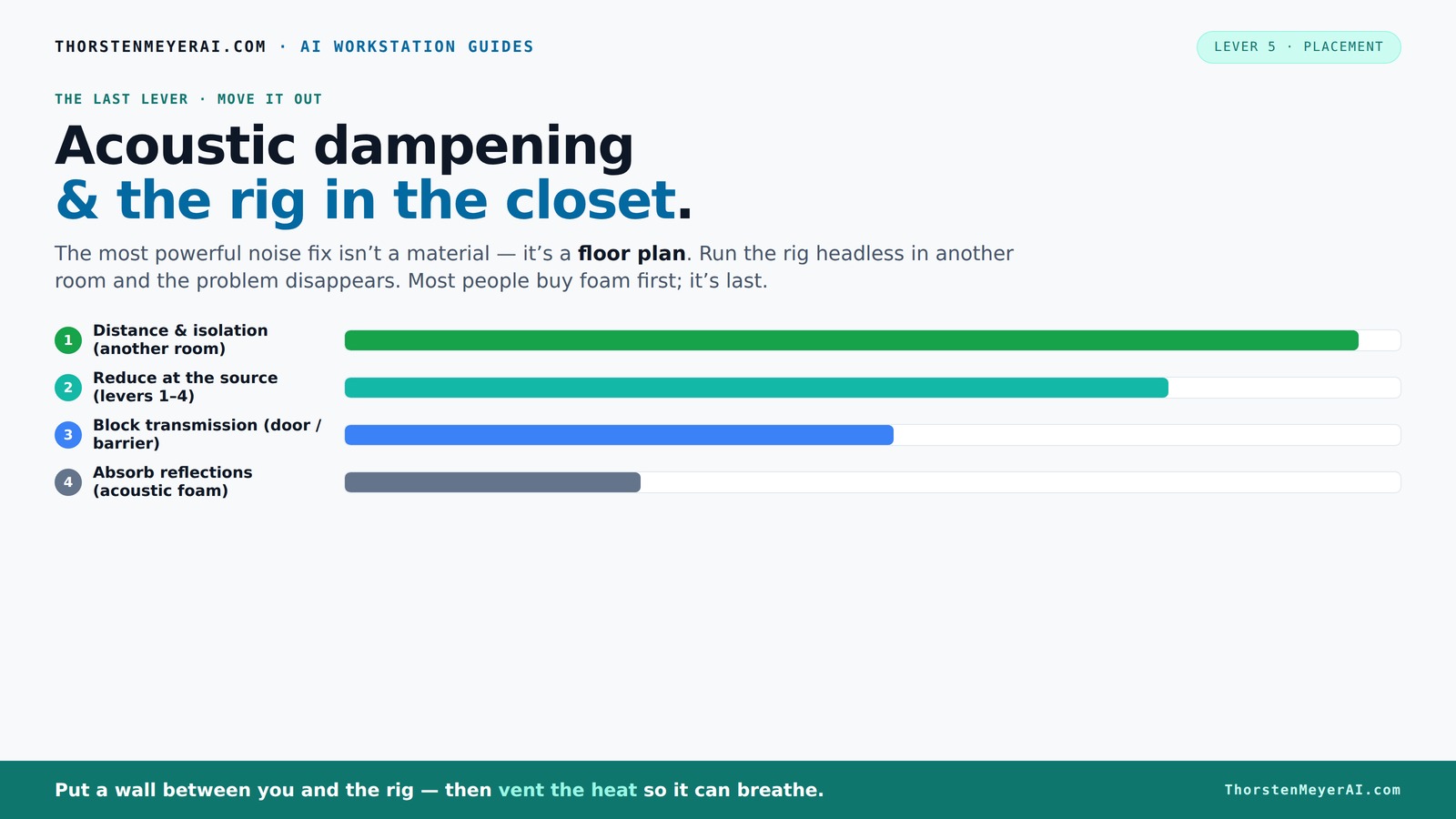
Acoustic dampening
& the rig in the closet.
The most powerful noise fix isn’t a material — it’s a floor plan. A rig you can’t hear because it’s in another room beats any amount of foam. Tap the approaches in Part 1 to see what actually works.
(another room)
(levers 1–4)
(door / barrier)
(acoustic foam)
Contain the noise, not the heat
Key Takeaways
- The most effective noise reduction is moving your rig into a different room or closet, not just adding foam.
- Proper ventilation prevents heat buildup, which can cause your hardware to throttle or overheat.
- Acoustic treatment should target reflection points—behind the mic, walls, and ceiling—for best vocal clarity.
- Seal gaps around the door and treat corners with bass traps to control low-end and prevent sound leakage.
- Balance is key: too much absorption makes a space sound dead; too little leaves echo.
soundproof closet acoustic treatment kit
As an affiliate, we earn on qualifying purchases.
As an affiliate, we earn on qualifying purchases.
Why Moving Your Rig Is the Best Noise Solution
The simplest way to cut noise? Just put physical distance between you and your noisy machine. A rig tucked away in another room, or even a closet, can be effectively silent from your workspace. This is often more impactful than any foam panel or barrier.
Imagine your GPU humming loudly on your desk. Now picture it in a closet two rooms away. The sound is vastly diminished—sometimes by over 90%. That’s because sound intensity drops with distance, following the inverse-square law. It’s like turning down the volume without touching the knob.
For most AI workstations, you don’t need the machine next to you. They’re accessed over network protocols—SSH, API calls. Your laptop or desktop can stay silent, while the rig roars in a distant closet, safe from your ears.
The 'Rig in the Closet' Setup — How to Do It Right
Placing your rig inside a closet sounds simple, but it comes with a big caveat: heat. A sealed space traps warmth, turning your closet into a sauna for your hardware. That can cause throttling, reduced lifespan, or even shutdowns.
To make a closet work, you need airflow. This means installing vents, exhaust fans, or even a small duct system. The goal is to keep hot air moving out and cooler air flowing in—think of it as a mini data center with ventilation.
For example, a DIY streamer I know built a cabinet with a vented panel, a quiet exhaust fan, and a temperature sensor. It keeps the temperature stable even under heavy load, while muffling the noise inside the room.
Learn more about how to balance heat and noise in your closet setup at this guide. It explains the essentials of ventilation and acoustic treatment, cooling, and noise reduction in detail.
Acoustic Dampening vs. Soundproofing: What’s the Difference?
Acoustic dampening and soundproofing are often confused, but they serve different purposes. Dampening reduces echoes and reflections inside a space, making recordings clearer. Soundproofing blocks sound from leaking out or in.
Think of it like this: foam panels inside a closet dampen the sound bouncing around—less flutter echo, better vocal clarity. But they won’t stop your noise from escaping through gaps or the door. For true soundproofing, you need mass, sealing, and decoupling—like adding drywall or sealing cracks.
For example, a small closet booth might have foam on the walls to tame reflections, but sealing the door and adding a heavy curtain prevents sound leakage. Both are needed for a quiet, clean space.
Where to Place Acoustic Treatment for the Best Results
The placement of acoustic panels and blankets matters more than you think. For detailed tips, see this guide on acoustic treatment. The first thing to treat is the wall behind your mic, since that’s where most reflections bounce back. Next, focus on the side walls and ceiling to reduce flutter echo and standing waves.
For example, if your mic faces a wall with a window or a hard surface, add absorption there. Use a combination of foam panels, blankets, or bass traps in the corners for low-end control. Layering soft materials helps tame both high and low frequencies.
In my own setup, I placed a foam panel directly behind my mic, with blankets draped over nearby hard surfaces. It transformed the sound from muffled to crisp, with minimal echo.
How Much Treatment Is Enough? Balancing Coverage and Deadness
More isn’t always better. In small closets, covering 20-30% of the walls with foam or blankets often improves clarity without making it sound dead or boxy. Larger coverage can help in bigger spaces but can also dull the sound if overdone.
For example, in a tiny 4x4 foot closet, I installed foam panels on the two side walls and the wall behind the mic. It reduced echo significantly, while leaving the space lively enough for vocals.
Use the 'near-total' coverage rule in very reflective rooms, but avoid overdoing it. Balance is key—aim for even absorption, especially in critical reflection points.
Treat the Door and Corners — The Weak Spots
The closet door is a major weak point for sound leakage and reflections. Hanging moving blankets, sealing cracks with weatherstripping, or installing acoustic seals can make a big difference.
For example, a YouTuber I follow sealed his closet door with weatherstripping and hung a thick moving blanket over it. The noise leakage dropped dramatically, and the overall room noise was better contained.
Similarly, corners accumulate low-end buildup. Bass traps or foam wedges in the corners can tame these low frequencies, preventing boomy, muddy sound.
Keep Your Closet Functional — Ventilation, Storage & More
Turning your closet into a rig shouldn’t turn it into a soundproof space. Plan for easy access, good lighting, and cable management. Ventilation is critical—learn more about ventilation and acoustic setup to keep your hardware cool.
For example, I installed a vent fan with a duct leading outside, so my rig stays cool even during long sessions. I also used a small shelf for gear and kept the door slightly ajar for airflow.
It’s about balancing noise control with usability—your workspace should still work as a closet, not just a soundproof box.
Frequently Asked Questions
Can I really turn a closet into a functional vocal booth?
Absolutely. With proper treatment, ventilation, and sealing, a closet can be transformed into a surprisingly effective vocal booth. Focus on reflection points, seal gaps, and add ventilation to keep everything cool.
How much acoustic treatment do I need for a small closet?
Usually, covering about 20-30% of the walls with foam or blankets is enough to reduce reflections and echo. The key is to treat the reflection points and corners, not necessarily the entire space.
Will foam panels soundproof my closet?
No, foam panels mainly absorb reflections inside the space. Soundproofing requires sealing gaps, adding mass, and decoupling the structure. Foam alone won’t block noise from escaping.
What’s the best way to ventilate a closet rig?
Install a quiet exhaust fan with ducting to outside, or create passive vents with a small fan. This keeps heat from building up while maintaining noise control. Regular monitoring of temperature is also a smart move.
Conclusion
In the end, noise reduction and sound quality come down to smart placement and practical treatment. A rig tucked away in a ventilated closet can be as quiet as a whisper, with excellent sound clarity. Focus on the big wins: distance, airflow, and strategic absorption.
Imagine your workspace—silent, cool, and perfectly tuned. That’s the power of a well-planned closet setup. Now go turn that noisy room into your secret studio hideout.
Fall Picks
fall essentials
As an affiliate, we earn on qualifying purchases.