TL;DR

Get wellness gear delivered free with Prime
- Fast, free delivery on millions of items
- Prime Video, Amazon Music and more included
- Member-only deals all year
Strength and conditioning coach Matt Van Mol shared a four-move resistance-band routine that he says he uses most days to work on shoulder, lower-back and hip mobility. The Fit&Well report describes each exercise and its suggested duration or repetitions, but does not provide independent evidence that the routine improves mobility for everyone.
Strength and conditioning coach Matt Van Mol has shared a four-exercise routine using a long-loop resistance band, saying he practises the moves most days to work on shoulder, hip and lower-back mobility. Fit&Well reported that the sequence takes about four minutes; that timing and the routine’s potential benefits are Van Mol’s descriptions, not results from a reported clinical trial.
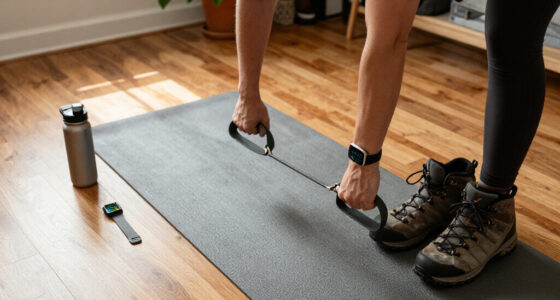
The routine consists of a shoulder rotation exercise Van Mol calls a “shoulder dislocation 2.0,” a banded cat-cow, a kickstand-stance hinge pulse and a band side bend. The report recommends starting with the lightest resistance and using a long-loop band. Its directions give a target of 10 to 12 repetitions for the shoulder movement, 60 seconds for the cat-cow, and 30 seconds per side for each of the remaining moves.
For the shoulder exercise, the user holds the band with hands wide, raises it overhead and rotates it behind the body before reversing the movement. The cat-cow is performed on hands and knees, with the band lightly pressing against the lower back as the person arches and rounds that area. In the hinge pulse, most weight stays on one leg while the person hinges at the hips and makes small pulses against band tension, then switches sides.
For the side bend, one end of the band is held while the other is looped around the same-side foot. The person bends the torso from side to side under control, then repeats on the opposite side. Van Mol co-founded resistance-band company Strong Band, according to Fit&Well. That business connection is relevant when weighing his comments about band use and the company’s product features.
Four Moves, Three Mobility Areas
The routine offers readers a short, equipment-based sequence rather than a general promise of improved flexibility: it focuses on shoulder rotation, controlled movement in the lower back, hip movement and side bending. The movements may interest people who want a brief mobility practice to add to a warm-up or daily routine, though the report does not establish that they are suitable for every person or that they produce lasting gains.
Van Mol distinguishes mobility from simply stretching, describing it as the range a person can control. He says bands can provide assistance into a position or resistance near the end of a range. Those are his explanations of the exercises, not independently tested findings included in the source. Readers should treat the sequence as an expert’s suggested routine, not individualized advice or a treatment for back pain.
Products Worth Considering

Garmin Venu 3S GPS Smartwatch with AMOLED Display, Soft Gold and French Gray Silicone Band

Therabody ThermBack LED 4-in-1 Heated Lower Back Relief Wrap

Withings BPM Vision Blood Pressure Monitor with Wi-Fi and Bluetooth
As an affiliate, we earn on qualifying purchases.
How Van Mol Describes the Routine
Fit&Well’s report presents the exercises as a routine Van Mol uses most days. It says he developed it after years of lower-back pain, but does not give a date for when he began the routine or detail how his symptoms changed. The source also identifies him as a strength and conditioning coach and co-founder of Strong Band.
Van Mol told Fit&Well that the band’s pressure can give feedback about which part of the back is moving during the cat-cow. He also said his company’s progress lines let users adjust band tension. This is a product-specific claim from a company co-founder; the report does not compare those lines with other ways to track resistance or assess progress.
““Mobility isn’t just how far you can stretch; it’s how much range you can actually control.””
— Matt Van Mol, strength and conditioning coach, speaking to Fit&Well
Evidence and Suitability Remain Open
The Fit&Well report describes Van Mol’s routine and instructions but does not cite a study measuring its results, compare it with other mobility routines, or show that it will help everyone with stiff shoulders, hips or lower backs. The reported four-minute duration is not accompanied by details of how it was measured, and “most days” does not specify a precise weekly schedule.
The source does not explain how to adapt the exercises for injuries, pain during movement, pregnancy or other health conditions. It also does not report whether Van Mol’s past lower-back pain improved because of this routine. People with ongoing or worsening pain, or a condition that affects exercise, should seek guidance from a qualified health professional before trying unfamiliar movements. The source’s business affiliation also means his comments about Strong Band features are not independent product testing.
How to Approach the Exercises
The article does not announce a study, follow-up or formal evaluation. Its immediate practical guidance is to use a long-loop band, begin with light resistance and follow the stated time or repetition targets, adjusting tension rather than forcing a deeper range. Readers should stop if a movement causes pain or feels unsafe and seek professional advice when needed.
Any assessment of whether the sequence produces lasting mobility changes would require information the report does not provide, such as consistent measurements over time and evidence from people beyond the coach describing the routine. Until then, the four moves are best understood as Van Mol’s personal mobility practice, not a proven outcome or a universal prescription.
Key Questions
What are the four resistance-band exercises?
They are a shoulder rotation exercise called “shoulder dislocation 2.0,” a banded cat-cow, a kickstand-stance hinge pulse and a band side bend.
How long does the routine take?
Van Mol told Fit&Well that the routine takes about four minutes. The report lists 10 to 12 repetitions for the shoulder move, 60 seconds for the cat-cow, and 30 seconds per side for the hinge pulse and side bend.
What resistance band does the routine require?
The report says to use a long-loop resistance band and advises starting with the lightest resistance. It does not require a specific brand, although Van Mol co-founded Strong Band.
Is the routine proven to improve mobility?
The source reports Van Mol’s routine and his reasons for using it, but does not cite research showing that it improves mobility for everyone. Its benefits should be treated as the coach’s claims and experience, not established results from a study described in the article.
Can anyone with back or joint pain try these moves?
The report does not assess suitability for people with injuries or health conditions. Anyone with ongoing pain or a condition affecting exercise should consult a qualified health professional before trying the movements, and should stop if an exercise causes pain.
Source: fitandwell.com