
TL;DR

Get wellness gear delivered free with Prime
- Fast, free delivery on millions of items
- Prime Video, Amazon Music and more included
- Member-only deals all year
Physical therapist Devin Trachman recommends the sit-to-stand as a practical strength exercise for people who want to support walking. Her suggested routine is two to three sets of eight to 10 repetitions, with chair arms or stable support available for people who need assistance. The report offers expert guidance, not evidence that this single exercise works for everyone.
Physical therapist Devin Trachman recommends the sit-to-stand exercise for people seeking to build lower-body strength that supports walking, according to a Fit&Well report. The exercise involves rising from a chair and sitting back down under control; Trachman’s suggested routine is two to three sets of eight to 10 repetitions, with support or modifications if needed.
Trachman, identified by Fit&Well as a clinical director and physical therapist at Physical Therapy Central in West Edmond, said standing up from a chair is a functional movement used in everyday life. The report says sit-to-stands work the quadriceps, gluteus maximus and core stabilizers, muscles involved in standing and other lower-body tasks. It does not provide trial results or data showing how much the exercise changes walking ability.
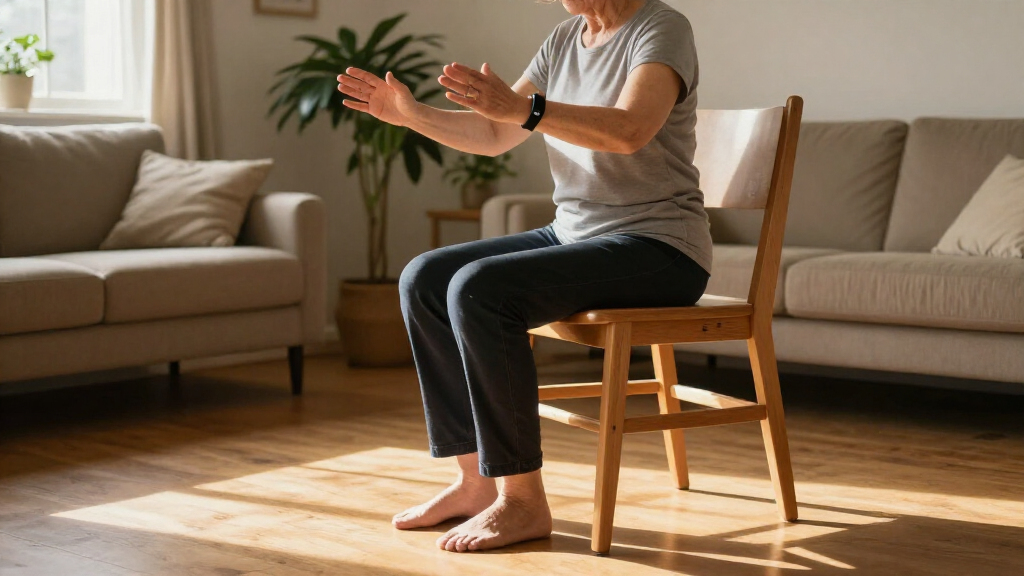
For the movement, the report advises sitting toward the front of a sturdy chair with feet flat and about shoulder-width apart. The person leans forward slightly with a straight back, pushes through the heels to stand upright, then lowers back into the seat in a controlled way. Trachman’s form tip is to avoid using the hands if possible, but the article gives alternatives: use a chair with armrests for light support or a stable support in front.
The recommendation is presented as a starting exercise, not a prescription tailored to every reader. Fit&Well’s report describes a plan of two to three sets, with eight to 10 repetitions and 60 seconds of rest. It does not state that readers should push through pain or specify how often each week to perform the routine.
Building Strength for Everyday Walking
The advice addresses a practical concern: walking can feel harder when strength, balance or endurance declines, and difficulty with everyday movement may affect independence. Trachman told Fit&Well that reduced activity can contribute to weaker walking muscles and lower endurance, which may make walking feel more challenging. That is her clinical explanation in the report, rather than a finding from a study presented there.
Sit-to-stands are relevant because they practice a movement people use to get up from a chair, while also challenging several lower-body muscle groups. The exercise can be adjusted by using armrests or support, which may make it more accessible to people who cannot yet rise without assistance. The report does not establish that this movement alone improves walking, prevents falls or preserves independence; outcomes will depend on a person’s health, ability and broader activity.
chair sit-to-stand exercise equipment
As an affiliate, we earn on qualifying purchases.
As an affiliate, we earn on qualifying purchases.
Why the Chair Rise Was Chosen
The report places the recommendation within a broader discussion of age-related changes in muscle and mobility. It says some people notice walking becoming shorter or less smooth, while Trachman points to other possible reasons people become less active, including busy schedules, pain and walking that feels tiring. The article’s focus is on building strength and confidence rather than simply advising people to walk more.
Trachman is described as a doctor of physical therapy and an orthopaedic clinical specialist, with experience in outpatient orthopaedics and rehabilitation. Fit&Well attributes the exercise recommendation and its rationale to her. The material supplied does not cite a clinical study, compare sit-to-stands with other exercises, or report an independent assessment of the advice.
““If I could only prescribe one exercise to improve walking, this would be it.””
— Devin Trachman, physical therapist, quoted by Fit&Well
Limits of the Exercise Advice
The source does not identify a publication date, cite research testing this routine, or give results from people who followed it. It is therefore unclear how much sit-to-stands may improve walking, how long any change could take, or whether the exercise is more effective than other strength or balance activities.
The report also does not specify who should avoid the movement, how to adapt it for particular injuries or health conditions, or how often to train. People with pain, balance concerns, significant weakness or existing medical conditions may need individualized advice from a qualified health professional. The article’s suggested repetitions should not be treated as a personalized rehabilitation plan.
Adapting the Movement Safely
The Fit&Well report provides a basic starting routine and modifications, but gives no follow-up schedule or planned research milestone. Readers who try the exercise can follow its instructions to use a stable chair, move with control and add light support if standing without the hands is not manageable. They should stop if the movement causes pain or feels unsafe and seek professional guidance for individual limitations.
Any assessment of whether the exercise helps a particular person would require tracking changes in comfort, strength and walking over time, ideally with advice suited to that person’s needs. The report does not set out such a monitoring plan or claim that every reader will see improvement.
Key Questions
What exercise does Devin Trachman recommend for walking?
Trachman recommends sit-to-stands: rising from a chair and lowering back into it under control. Fit&Well reports her suggested routine as two to three sets of eight to 10 repetitions, with 60 seconds of rest.
Which muscles does a sit-to-stand work?
The report lists the quadriceps, gluteus maximus and core stabilizers. Trachman says the movement builds lower-body strength used for everyday tasks such as standing and climbing stairs.
What if I cannot stand up without using my hands?
The report suggests using a chair with armrests for light support or a stable support in front. It does not require readers to perform the movement hands-free.
Does the report prove sit-to-stands improve walking?
No. It reports a physical therapist’s recommendation and explanation, but supplies no study results or measured outcomes showing how much the exercise changes walking ability.
Should everyone follow the same routine?
The routine is general guidance, not an individualized plan. People with pain, balance problems, injuries or health conditions should consult a qualified professional about whether and how to do the exercise safely.
Source: rss
Cold & flu season Picks
humidifiers
As an affiliate, we earn on qualifying purchases.