
TL;DR

Get wellness gear delivered free with Prime
- Fast, free delivery on millions of items
- Prime Video, Amazon Music and more included
- Member-only deals all year
Researchers have developed a guided-lighting app that uses smartphone cameras to objectively measure tooth shade, offering a potential breakthrough for home whitening. The technology aims to help users track progress accurately and select effective products, with validation against dental standards underway.
A new smartphone-based method for measuring tooth shade objectively has been introduced, aiming to assist home whitening users in tracking their progress more accurately. Developed as a guided-lighting photo flow, this technology uses phone cameras to approximate dental shade readings typically performed by dentists, offering a potential solution to the common problem of subjective, mirror-based assessments. The approach is being tested for its effectiveness in providing reliable, repeatable measurements that could help consumers make better decisions about whitening products and monitor their results over time.
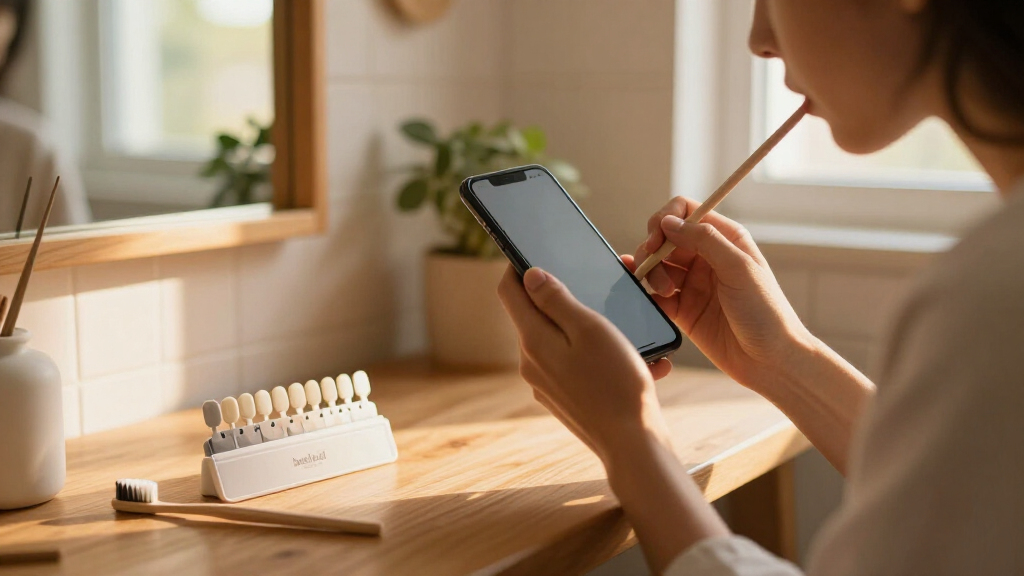
The proposed system involves a guided-lighting protocol that users follow when taking photos of their teeth with a smartphone. The app calibrates the lighting conditions and captures images that are then analyzed to assign a tooth shade score based on the dental shade scale. This score can be plotted over weeks, allowing users to see which products are effectively whitening their teeth. The developers aim to validate these scores by benchmarking them against dentist VITA shade readings in a study involving fifty participants. If the correlation proves strong, the technology could serve as an objective, accessible tool for millions of home whitening consumers.
According to the developers, the app not only provides a shade score but also tracks progress over time, compares results against similar users, and recommends products that have historically moved the shade score for users starting at similar levels. The goal is to create a subscription-based service supplemented by affiliate revenue from recommended products, creating a new measurement layer in the crowded home whitening market. This innovation addresses a key pain point: the lack of objective measurement in at-home whitening routines, which often rely on subjective visual assessments that can be inconsistent and inaccurate.
Potential Impact on Home Whitening Effectiveness
This development could significantly improve the way consumers approach home teeth whitening by providing an objective, easy-to-use measurement tool. Currently, most users rely on subjective visual assessments in the mirror, which can lead to over- or underestimating results and unnecessary product cycling. An accurate, smartphone-based shade measurement could reduce trial-and-error, help users select the most effective products, and motivate consistent progress tracking. If validated, this technology might also influence the broader oral-care market by integrating more precise, data-driven approaches into everyday routines, supporting better outcomes and customer satisfaction.
As an affiliate, we earn on qualifying purchases.
Advances in Smartphone-Based Dental Shade Measurement
Recent years have seen growing interest in leveraging smartphone technology for health and beauty applications. In dental care, some apps have attempted to provide shade matching through manual photo uploads, but these often lack calibration or standardization, leading to questionable accuracy. The new approach from IdeaNavigator AI introduces a guided-lighting protocol designed specifically to address these issues by controlling lighting conditions and analyzing images against a calibrated scale. The concept builds on existing research that shows phone cameras can approximate professional dental shade readings when used with proper lighting and calibration. This initiative is part of a broader trend toward democratizing dental diagnostics and aesthetic assessments, making them accessible outside of clinical settings.
“Using guided lighting and calibrated analysis, smartphone cameras can now approximate dentist-grade shade readings, opening new possibilities for at-home dental care.”
— an anonymous researcher
Validation and Accuracy of Phone-Based Shade Scores
While initial testing involves benchmarking app-generated shade scores against dentist VITA readings in fifty users, the strength of the correlation remains to be confirmed. The developers acknowledge that further validation is necessary to establish the reliability and consistency of the measurements across different devices, lighting environments, and user techniques. It is also unclear how well the system will perform with users having varying tooth colors, stains, or dental restorations, which can complicate shade matching. Until comprehensive validation is completed, the technology’s accuracy and practical utility remain provisional.
Next Steps in Validation and User Testing
The next phase involves completing the validation study with fifty participants, comparing app scores with professional dental readings. If results show a strong correlation, the developers plan to refine the app’s algorithms and expand testing to larger, more diverse populations. They also intend to develop user-friendly tutorials and calibration guides to ensure consistent photo quality. Following successful validation, a pilot launch of the subscription service is expected, alongside ongoing research into integrating the system with existing whitening products and routines. The ultimate goal is to establish this as a standard tool for home whitening progress monitoring and product selection.
Key Questions
How accurate is the phone-based tooth shade measurement?
Initial validation involves benchmarking against dentist VITA readings, but the accuracy depends on calibration and lighting conditions. Further testing is needed to confirm reliability across diverse users and environments.
Can I use this system with any smartphone?
The system is designed to work with smartphones that can support guided-lighting protocols and have cameras capable of capturing detailed images. Compatibility details are being finalized during the validation phase.
Will this replace professional dental shade matching?
No, it is intended as a home-use tool to support progress tracking. Professional assessments remain the gold standard, but this technology aims to provide a useful objective measure for consumers.
When will the system be available for consumers?
After validation and further development, a pilot launch is expected within the next year, with broader release contingent on testing outcomes.
Source: IdeaNavigator AI
Halloween Picks
halloween
As an affiliate, we earn on qualifying purchases.