
TL;DR

Get wellness gear delivered free with Prime
- Fast, free delivery on millions of items
- Prime Video, Amazon Music and more included
- Member-only deals all year
A Fit&Well writer says he helped his 73-year-old father return to strength training with goblet squats, single-arm rows and overhead presses. The report offers three sets of eight to 12 repetitions for each exercise, along with easier variations; it does not provide measured results or a complete weekly schedule.
Fit&Well has published a first-person report describing how a writer helped his 73-year-old father return to strength training with three dumbbell exercises: a goblet squat, single-arm row and overhead press. The plan is presented as a time-conscious way to work several movement patterns, but the report provides no measured results or evidence that this specific routine produced particular health outcomes.
The writer says his father had been active but had recently let strength training lapse while caring for his wife, who has Parkinson’s. The writer, who describes himself as a personal trainer, bought him light-to-medium dumbbells and reviewed basic lifting technique, including keeping weights close, bracing the core and maintaining an upright posture. They spent a few weeks practicing bodyweight movements before adding the three exercises.
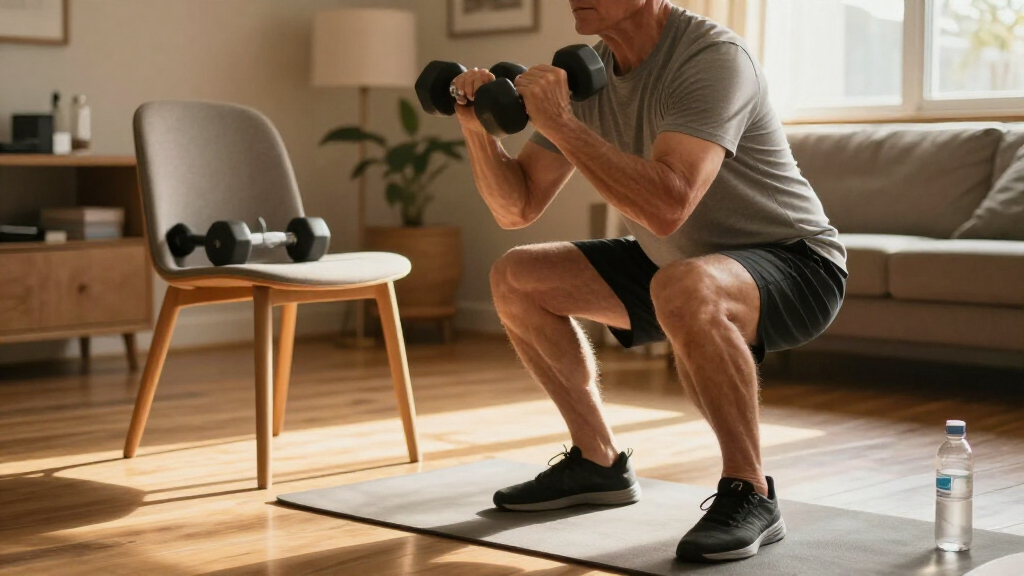
For each movement, the suggested program is three sets of eight to 12 repetitions. In the goblet squat, a dumbbell is held at the chest while the person bends at the hips and knees, then presses back to standing. The report connects the motion to everyday sit-to-stand tasks and suggests starting with bodyweight squats or chair-assisted sit-to-stands if needed.
The single-arm row is performed with one hand supported on a sturdy surface as the lifter hinges forward and pulls a dumbbell toward the ribs. The writer says it trains the back and a pulling movement used in daily tasks; a one-knee kneeling position is offered as a more stable option. In the overhead press, weights start at shoulder height and are pressed overhead. A seated version with back support, or pressing one arm at a time, is suggested as an easier alternative.
A Short Routine Built Around Daily Tasks
The three exercises cover lower-body bending and standing, upper-body pulling, and reaching overhead. Those movements appear in ordinary activities such as rising from a chair, lifting a bag and reaching for an object. That makes the report relevant to readers looking for a simple strength-training template rather than a long or specialized workout.
Still, the article describes one family’s approach, not a clinical study or a tested program for all older adults. Its practical value lies in the exercise choices and lower-difficulty options; it does not establish that the routine prevents injury, reverses age-related changes or improves a person’s health by a particular amount.
The writer’s account also highlights a common constraint: his father had limited time because of caregiving responsibilities. A short list of movements may be easier to organize than a complicated plan, though the report does not state how often his father completed the workout or how long each session took.
As an affiliate, we earn on qualifying purchases.
Technique Before Adding Dumbbells
Before using weights, the writer says he and his father spent several weeks practicing bodyweight versions of basic patterns, including squatting, hinging at the hips, lunging and pushing. He then emphasized form cues such as keeping the back upright, engaging the core and controlling the movement. The sequence matters to understanding the plan: it was not described as an immediate jump into loaded exercises.
The report gives a general repetition and set range but does not specify a weekly frequency, rest periods, starting dumbbell weights or a progression schedule. It also does not describe a formal assessment of the father’s fitness, mobility or medical history. The recommendations are therefore best read as the writer’s account of a routine for his father, not individualized guidance for every reader.
Results and Training Schedule Not Given
The report does not say how often the father performs the routine, what weights he uses, whether he completed all prescribed sets, or what changes he experienced in strength or mobility. It provides no independent assessment or follow-up measurements, so the effects of the plan remain unknown.
It is also unclear whether the father received advice from a health professional before starting or whether he has limitations that would affect exercise selection. The article’s adaptations offer lower-demand options, but they do not determine whether a movement is suitable for a particular person.
How Readers Can Apply the Ideas
The Fit&Well report does not announce a follow-up or set a next milestone for tracking the father’s progress. Readers considering similar movements can use the listed variations as a starting point, begin at a manageable level and increase resistance only when they can maintain controlled form. A sturdy chair or support surface is part of the suggested easier versions.
Older adults who are new to strength exercise, have pain or balance concerns, or live with a health condition may want to ask a qualified health professional or fitness specialist for guidance before starting. The report’s central recommendation is specific: practice movement patterns first, then consider a small program built around a squat, row and press.
Key Questions
What are the three exercises in the routine?
The routine uses a dumbbell goblet squat, a single-arm dumbbell row and a dumbbell overhead press.
How many sets and repetitions does the report suggest?
It lists three sets of eight to 12 repetitions for each exercise. It does not specify weekly frequency or rest periods.
What easier versions does the report describe?
It suggests bodyweight or chair-assisted squats, a kneeling row for extra stability, and a seated overhead press with back support. The press can also be done one arm at a time.
Does the report show that the routine improved the father’s strength?
No measured results are included. The article describes the writer’s plan for his father but does not report strength tests, mobility measurements or a specific outcome.
Source: rss
Halloween Picks
halloween
As an affiliate, we earn on qualifying purchases.