
TL;DR
PGSimCity, a simulation platform, demonstrates how PostgreSQL can be utilized for complex data management. The development showcases PostgreSQL’s capabilities in handling large-scale simulations, with confirmed technical insights and ongoing exploration of its potential.
PGSimCity, a simulation platform focusing on urban planning, has publicly detailed how it leverages PostgreSQL to handle its data operations. This development offers a concrete example of PostgreSQL’s application in large-scale, real-time simulation environments, highlighting its flexibility and robustness.
The PGSimCity team published a comprehensive technical overview explaining how they utilize PostgreSQL to manage city simulation data, including population metrics, infrastructure models, and real-time updates. According to their documentation, PostgreSQL’s support for complex queries, concurrency, and extensibility enables the platform to process large volumes of data efficiently. The developers emphasized that PostgreSQL’s open-source nature allows for customization tailored to simulation needs, such as custom data types and advanced indexing techniques. While the overview confirms the use of PostgreSQL as a core component, specific details about performance benchmarks, scalability limits, or integration with other technologies remain undisclosed. The developers also noted ongoing efforts to optimize database performance further and explore PostgreSQL’s newer features, such as partitioning and parallel query execution, for future updates.Implications of PostgreSQL’s Role in PGSimCity’s Architecture
This development underscores PostgreSQL’s versatility beyond traditional data storage, illustrating its suitability for complex, real-time applications like urban simulation. For developers and organizations considering open-source solutions, PGSimCity’s example demonstrates how PostgreSQL can be adapted to handle demanding data workloads, potentially influencing future choices in simulation, gaming, and large-scale modeling projects. It also highlights the growing trend of leveraging mature database systems in innovative ways, supporting scalability and customization without proprietary constraints.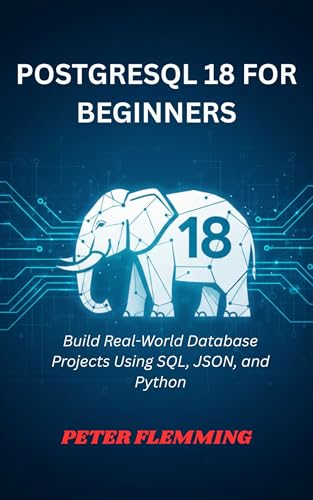
POSTGRESQL 18 FOR BEGINNERS: Build Real-World Database Projects Using SQL, JSON, and Python
As an affiliate, we earn on qualifying purchases.
As an affiliate, we earn on qualifying purchases.
PostgreSQL’s Growing Adoption in Simulation and Data-Intensive Projects
PostgreSQL has long been recognized for its stability and extensibility in enterprise data management. Recently, its adoption has expanded into areas such as geographic information systems (GIS), scientific research, and now, simulation platforms like PGSimCity. The platform’s detailed technical overview provides insight into practical implementations, suggesting a broader interest in open-source databases for real-time, high-volume environments. Prior to this, PostgreSQL’s capabilities have been demonstrated in various large-scale projects, but PGSimCity’s focus on urban simulation offers a new perspective on its application scope.“Our use of PostgreSQL allows us to handle complex, dynamic data efficiently, enabling real-time city simulations that are both scalable and customizable.”
— PGSimCity Development Team
Unconfirmed Aspects of PostgreSQL’s Performance in PGSimCity
It is not yet clear how PostgreSQL’s performance scales under extremely large simulations or during peak load scenarios. The PGSimCity team has not disclosed specific benchmarks or stress test results, leaving questions about its limits in high-demand environments.Future Developments and Potential Enhancements in PGSimCity’s Database Use
PGSimCity plans to publish detailed performance metrics and explore advanced PostgreSQL features such as partitioning and parallel query execution. The team also intends to share updates on scalability testing and integration with other data management tools, which could further demonstrate PostgreSQL’s capabilities in simulation contexts.Key Questions
How does PGSimCity utilize PostgreSQL in its architecture?
PGSimCity uses PostgreSQL to manage and process large volumes of simulation data, leveraging its support for complex queries, extensibility, and concurrency to enable real-time urban modeling.
What advantages does PostgreSQL offer for simulation platforms?
PostgreSQL’s open-source nature, customizable data types, and advanced indexing make it suitable for handling complex, high-volume data environments typical of simulation platforms.
Are there any performance benchmarks available for PostgreSQL in PGSimCity?
As of now, the PGSimCity team has not released detailed benchmarks or stress test results, so the performance under extreme loads remains unconfirmed.
Could PostgreSQL be used in other real-time simulation projects?
Yes, PostgreSQL’s features make it a promising candidate for other real-time, data-intensive applications, although specific performance assessments are needed for each case.
What are PGSimCity’s next steps regarding database optimization?
The team plans to explore PostgreSQL’s newer features like partitioning and parallel query execution to improve scalability and performance in future updates.
Source: hn